

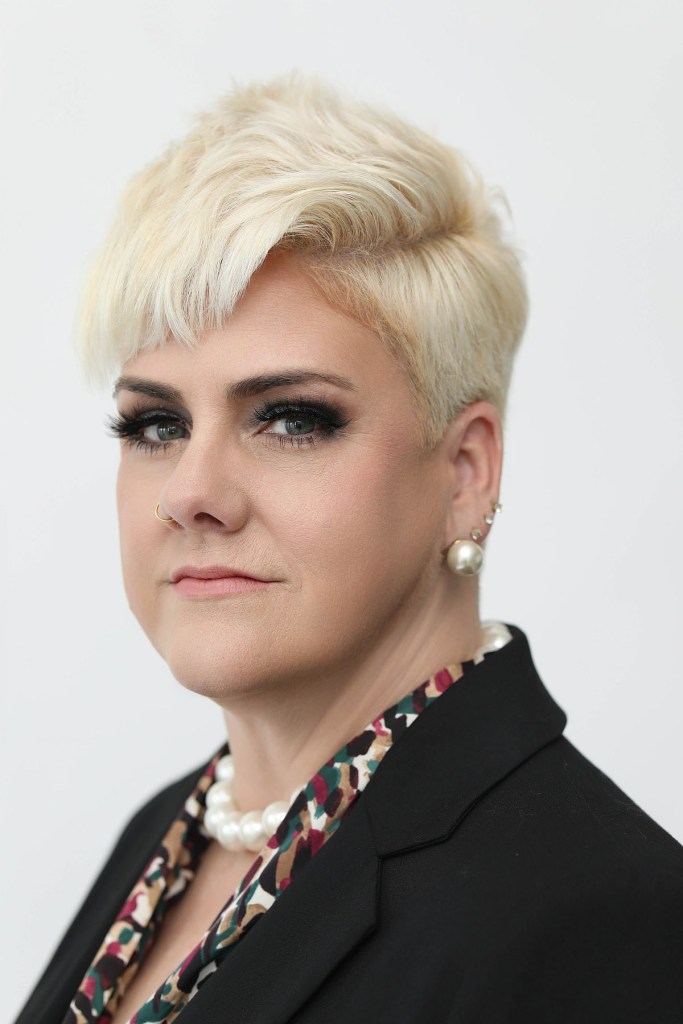
How the GOP motivated these women faith leaders to run for Congress as Democrats
Sarah Trone Garriott, an ordained Lutheran minister since 2008, was invited to lead prayer at the Iowa State Capitol by her then-state senator. She started coming to the statehouse, which was only 10 miles from her house, to advocate on issues she cared about, including public school funding, gun violence prevention and reproductive rights.
“I started paying attention to what was happening in that building, and I didn’t like what I saw,” Trone Garriott said. “And so I ended up running against him a few years later.”
She ran as a Democrat and won that race, in 2020, then moved to flip another district blue two years later. In 2024, Garriott was reelected to a four-year term — beating the Republican challenger by only 29 votes.
Though she eked out a victory, several Democratic colleagues lost their seats. Trone Garriott was worried about what was next for her state and country.
“I was looking for a way forward. How can I have hope in this moment? What can I do next? Because whenever I see a problem, my response is, how can I make things better?” Trone Garriott said.
For her, the answer was to run for Congress and try to flip the House. She’s challenging Republican Rep. Zach Nunn in Iowa’s 3rd Congressional District, which President Donald Trump won by about four points in 2024.
While Black clergy members have held office as Democrats — Sen. Raphael Warnock of Georgia and Rep. Emanuel Cleaver of Missouri are pastors — it’s been less common for White Democrats, and even less common for women. Trone Garriott is one of three Democratic women clergy members running for Congress this year to make more space for religion in their party as the GOP has embraced Christian nationalist talking points and policies.
Trump on Sunday night posted an image, likely created with artificial intelligence, that showed the president as a Jesus-like figure in a white and red robe with golden light radiating from his hand as he touched the forehead of a sick man. The backlash was immediate, including from prominent conservatives who called it blasphemous. In a rare move, Trump removed the post by Monday morning — though he did not apologize, insisting he was depicted as a doctor, not Jesus Christ.
In his second term, Trump has tried to establish himself as a champion for Christianity, painting the Democratic Party as its enemy. In his first weeks in the Oval Office, he signed an executive order to create a task force eradicating “anti-Christian bias” within the federal government. And earlier this year, the president claimed that the Democratic Party was “against” religion at the National Prayer Breakfast and said, “I don’t know how a person of faith can vote for a Democrat.”
The “God Gap” — the political divide as Republicans predominantly draw from religious voters and Democrats rely more on the religiously unaffiliated — remains a defining feature of American politics. Still, this year an influx of Democrats with religious backgrounds are trying to appeal to moderates and mobilize turnout with their own religious backgrounds.
At least nine current and former Christian faith leaders, including state Rep. James Talarico in Texas, are running for Congress as Democrats, according to Vote Common Good, a progressive nonprofit that seeks to engage religious voters and tracks religious candidates.
Doug Pagitt, the organization’s executive director and founder, said this is the highest number the group has recorded. Pagitt said it is quite common for faith leaders to run as Republicans and more common for Black clergy to run as Democrats — but this year is seeing a “pretty unprecedented” number of White Democratic faith leaders as candidates.
Another Iowan, Lindsay James is aiming to flip a district. James is a Presbyterian chaplain who’s running for the open 2nd Congressional District, which Trump won by about 10 points in 2024. In Tennessee, Anna Golladay, a former Methodist pastor, is mounting a long-shot bid to flip the bright red 3rd Congressional District, which Trump won by more than 35 points in 2024.

(Courtesy of Anna Golladay)
Pagitt said these Democratic faith leaders are being motivated by the Trump administration’s push for Christian nationalism and a growing acceptance among Democratic voters of candidates with faith backgrounds — a shift that Pagitt said Vote Common Good has advocated for since 2018.
“These candidates watched how the Trump administration has weaponized religion and the way Christian nationalism has been put forward,” Pagitt said. “They are putting themselves on the ballot as if it say, ‘Christian nationalists are not going to speak for all Christians.’”
Trone Garriott said her district voted for Trump, but it also voted for her. She said it’s important to be open about faith, even as a member of the Democratic Party.
“I think people are realizing that there’s been a vacuum that was created by well-intentioned people not talking about how faith and politics intersect, and the vacuum was filled by the religious right,” Trone Garriott said.
Trone Garriott, who no longer serves a congregation but continues to preach at different churches on the weekends, said she sees many similarities between her role as pastor and politician. Both are about being present, listening, trying to help, being someone people can look to for direction, she added.
“Faith is important to people and speaks to how we live together as a community, and that’s what politics does too,” Trone Garriott said.
In 2018, James — an ordained Presbyterian minister who had served as a chaplain at several college campuses across the country — won a seat in the Iowa House of Representatives.
She was inspired to run two years earlier after having a conversation with her then-6-year-old daughter about the newly elected president and the challenges the country faced.
“It became so clear to me in that moment, looking into the eyes of my daughter, what was at stake,” James said. “And I had a deepening sense of call that everyone who is able to do more should do more.”
In 2025, James decided to run for federal office when Congress voted to pass Trump’s “one, big, beautiful bill” — a sweeping package of tax cuts that James said puts 27,000 Iowans in her district at risk of losing their health care.
“It was another one of those moments where I knew I had to dig a little bit deeper and do more,” James said. “It became very clear to me, with all of these experiences knocking on doors and hearing these stories, how much harm was coming from policies in D.C.”

(Courtesy of Lindsay James)
For the past eight years as a state legislator, James said she has heard story after story about the difficult financial decisions that Iowans are making: One mother had to choose between paying a utility bill or buying her child a winter coat; a man said he had to decide whether to keep his mobile home or pay for insulin medication that allows him to keep his foot.
“These are the kinds of impossible choices that my neighbors are facing here in Iowa, and they’re doing that in one of the wealthiest countries in the world,” James said. “I think we can all agree that that’s not right.”
James said her leadership style is guided by the Parable of the Good Samaritan — a Biblical story about a Samaritan man who stops on the side of a road to help a Jewish man who was beaten by robbers, even though the two groups were enemies.
“A lot of what I have wrestled with as a person of faith in public life is around the fact that I am responsible not only to help the person who is struggling right in front of me, but also to fix the systemic issues that are causing the problems in the first place,” James said. “And so that parable has actually informed how I think about every single policy issue.”
Anna Golladay, a former Methodist pastor in Tennessee, said the deaths of Renee Nicole Good and Alex Pretti in Minneapolis amid federal immigration crackdowns pushed her to run for Congress.
“I have many friends who are faith leaders in Minneapolis, and I was keeping up with them and the work that they were doing in the streets,” Golladay said. “And I just had this kind of unending nag that I needed to do something. And the switch flipped pretty quickly for me after Pretti was murdered.”
She wanted to be in Congress in part to sway votes on funding for immigration operations. She wanted to run to keep Rep. Chuck Fleischmann, her Republican opponent who has been in office since 2011, from being unopposed.
Golladay said she sees her religious background as an advantage in Tennessee’s 3rd District, which she described as “the buckle of the Bible Belt.” For years, Chattanooga has had one of the highest church densities per capita.
“There is an expectation where I live that you are often more informed by faith than not, regardless of what your attitude toward it is,” Golladay said.
In fact, it is her political identity that is more of a stumbling block for voters than her religious one. Golladay said she has knocked on Republicans’ doors before only to be told that they can’t vote for a Democrat because they’re Christian.
“I will often chuckle to myself when I hear that,” Golladay said. “For me, it opens a door. That’s a very easy beginning of a conversation.”
When Golladay attended seminary, she read the Gospel and said Jesus’s teaching was clear: Clothe the naked, feed the hungry, shelter the unhoused and care for the poor.
“I think we have allowed a lot of the work and stories of Jesus to be co-opted by Christian nationalists — a type of religion that I don’t think recognizes the point He was really trying to make. I am highly influenced by the stories of care and empathy in the Bible, and I think that we are largely losing sight of that call.”