

Two millennial dads are making MAHA moms’ priorities a campaign strategy
GRIMES, Iowa — Zach Lahn looked out into a crowded room of potential Iowa voters. When he spoke, it was no surprise that the Republican nominee led with the two issues he’d brought up most often on the campaign trail: Iowa’s increasing cancer rates, and whether the state’s water has something to do with it.
“Clean water is a pro-life issue. Low cancer rates is a pro-life issue,” Lahn said at his late-September event in the Des Moines suburb, nodding to his support for an existing statewide abortion ban. “It is time that we overturn every single stone, no matter what special interest group says not to. We are going to clean up the water in Iowa and work alongside our farmers to do it.”
The crowd erupted into cheers.
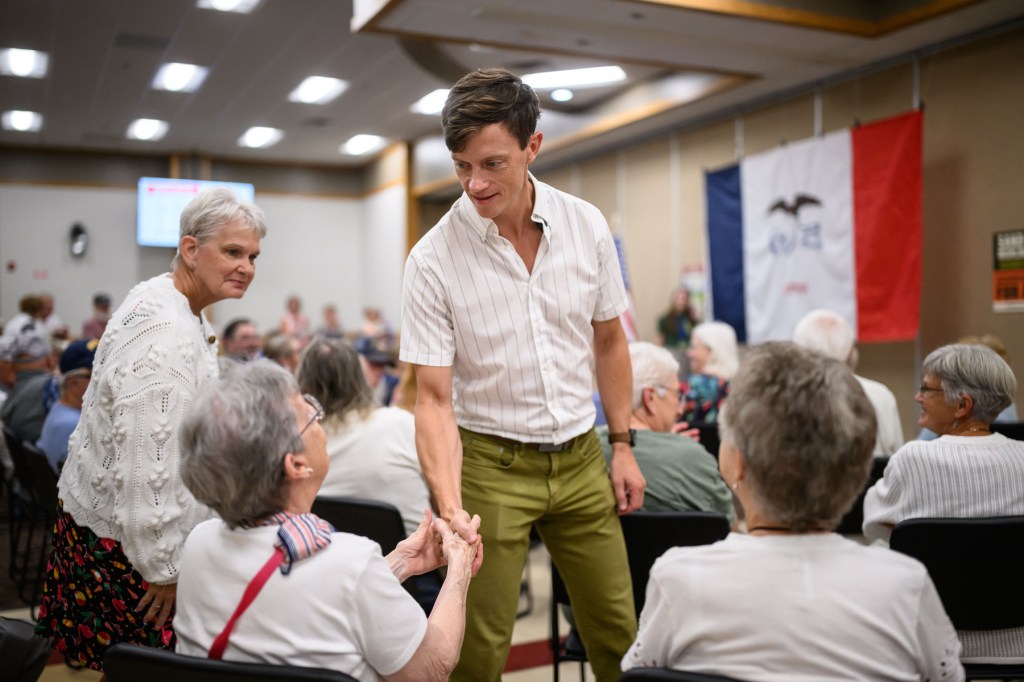
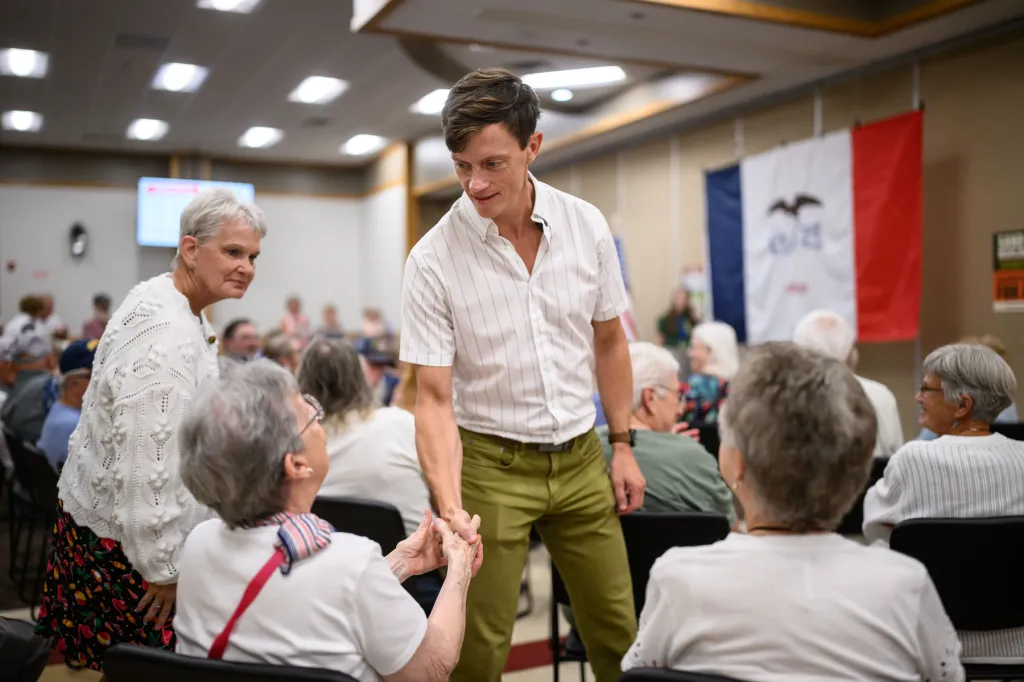
At nearly the same time, about 10 miles south, Democratic nominee Rob Sand was speaking to a bigger crowd at a venue usually reserved for concerts. He was marking the completion of a 99-county tour of the state — his second in his more than year-long bid for governor.
As Sand gave a rundown of his background, he also explained to the audience why he joined the Democratic Party in his early 20s and how faith played a role in his decision.
“Big believer that what you do the least of these, you do to me,” he said. “I also really like to drink water, and I like to fish, and the Democratic Party tends to be more concerned about having clean water,” he added.
(Leon Neal/Getty Images)
In a midterm election year where voters in other parts of the country are weighing which candidates will help address rising inflation and the growing costs of groceries, these millennial dads have also taken any chance they can to bring up health issues that have become priorities for Iowa voters: children’s health, nutrition and the role water may play in chronic health issues like cancer. These also intersect with the priorities of the Make America Healthy Again movement powered by women and moms.
“Women are much more motivated by the healthcare issue than are men in part because they purchase so much more healthcare, either on behalf of themselves or on behalf of family members, especially aging parents and young children,” said Karen M. Kedrowski, a political science professor at Iowa State University and director of the Carrie Chapman Catt Center for Women and Politics. “It’s a way of appealing to women voters without necessarily saying that you’re appealing to women voters, but you know the issue is salient. So the question is, which women do you want to reach and motivate?”
Just weeks from Election Day, polling shows Sand is increasingly favored to win — the nonpartisan Cook Political Report has rated the race as leaning Democrat. But in a state that has heavily favored Republicans in recent years, Lahn is still making his case to voters.
“Every single poll says we’re down,” Lahn, whose close primary win surprised many, told his supporters in Grimes. “You know who else they said was down? Donald Trump in 2024 in Iowa.” The president ultimately won Iowa that year by more than 13 points.
Two years later, voters are expected to treat the midterms as a referendum on Trump’s return to office, which could hamper Lahn’s chances. But if he wins, the race could breathe new life into MAHA as a political campaign strategy after months of national infighting over policy priorities. It may also scramble how some national Republicans approach their 2028 aspirations, given Iowa’s importance as the first nominating state for Republicans.
Lahn’s two-part pitch is based on the badges of honor he seems to wear proudly: his identity as a dad and being a candidate supported by the MAHA movement that purports to focus on addressing chronic disease and improving overall health outcomes. He touts being the first candidate ever backed by MAHA Action, one of the political entities supporting like-minded candidates.
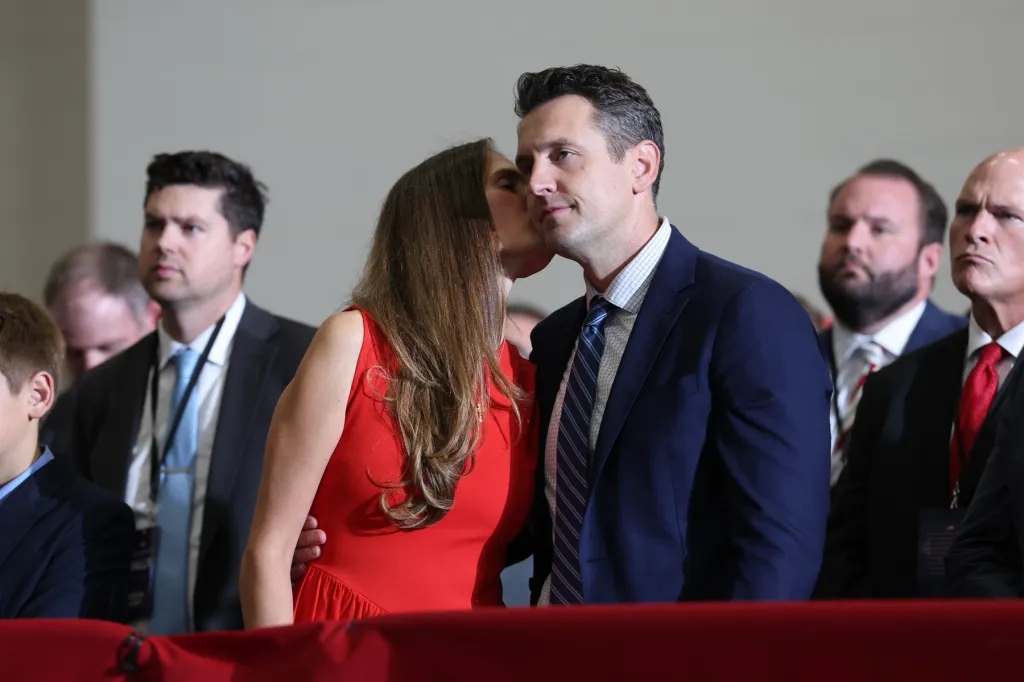
At another town hall in early September, the 40-year-old Republican gave a shout-out to his wife, Annie, and their toddler-aged son, Fritz. Lahn joked that Fritz, the youngest of seven in the couple’s blended family, was probably playing with toys nearby.
“People think this is a campaign for governor … it’s actually Fritz’s Iowa tour of playgrounds across the state,” he said to chuckles from a crowd of mostly older women and men.
The imagery of Lahn as a family man was omnipresent that day. Fritz bounced a basketball back and forth as his father spoke inside a small gymnasium in Sac City, and he later animatedly smashed play-doh with a yellow toy truck during remarks at a history museum in Clarion.
“Our kids eating healthy food is a pro-life issue,” Lahn told the Sac City crowd, repeating his oft-cited refrain in relation to wanting more fresh produce in Iowa schools.
Children, and particularly their health, are central themes for Lahn, a former political operative for the conservative advocacy group Americans for Prosperity who has never held elected office. He campaigns on a message of “Iowa First” but identifies with the MAHA platform that helped to not only secure Trump’s close reelection in 2024 but also to further elevate the national profile of Robert F. Kennedy Jr., who now leads the Department of Health and Human Services.
Lahn and Kennedy went fishing together in August. In a social media post touting their catch, Kennedy called Lahn a “MAHA gubernatorial race superstar and regenerative farmer.”
Iowa is the number one producer of hogs and eggs in the nation and a top producer globally of corn and soybeans. Lahn, who identifies as a farmer and businessman, leans into it on his website. Looped video of Iowa farmland sits alongside a prominent endorsement banner from MAHA Action, a nonprofit founded by Tony Lyons, a political organizer who oversees other MAHA-related entities and publishes Kennedy’s books. The group, which donated $1 million to Lahn’s campaign this fall, has endorsed several candidates around the country this midterm cycle.
“Iowa has a rich history of caring about the next generation, and so I think even people without kids, they want to see healthy kids in the state,” Lahn told The 19th last month. “They want to see lower obesity rates. They want to see lower chronic disease. They want to see healthier food for kids. I actually think it’s something that resonates with just about every voter across the state.”
Since right after announcing his bid last fall, Lahn has campaigned on addressing Iowa’s high cancer rates and cleaning up the state’s water.
“This is not a Republican or Democrat issue,” Lahn said at an event in Clarion. “Everybody’s drinking the water.”
(Anna Moneymaker/Getty Images)
It’s hard to pinpoint why cancer and water have dominated this race, but Iowa researchers have been examining cancer outcomes for some time. The numbers are stark: Iowa has the second-highest cancer incidence rate in the United States, and is one of only a handful of states to see its rate continue to rise. While the link to water quality is nuanced, the concern has gained enough momentum to dominate the governor’s race at a moment when more people are weary of dynamics like corporate agriculture ownership — Lahn has said he’s committed to breaking up “Big Ag” — and how it’s shaping use of chemicals in food production in the state. Sand has said he wants to ensure there’s no immunity for chemical companies that sicken residents. Both candidates say they want better water monitoring and support local Iowa farmers.
“A lot of people are worried about water quality,” Kedrowski said, adding: “A lot of people are concerned that that is connected to Iowa’s high cancer rates, and more and more people are sort of calling for the state to regulate big agriculture or take other steps to ensure that there’s good water quality statewide.”
In mid-September inside a gymnasium at a sprawling sports complex in West Des Moines, Sand stopped early in his town hall and asked the audience to sing the first verses of “America the Beautiful.”
“Someone over here kick us off. Pick a note, start singing and we’re all going to join you,” he said as some in the audience nervously laughed.
O beautiful for spacious skies…
The singing grew louder as the crowd got more comfortable.
And crown thy good with brotherhood, from sea to shining sea!
Folks burst into applause.
“Shouldn’t politics feel like that all the time, right? I mean you get a bunch of people in the room, you don’t limit it by a party affiliation, but you get together and say, ‘Guess what? We’re going to disagree on stuff,’” Sand said.
Sand, who faced no serious Democratic challenger in the primary, has criticized the two-party system as a theme of his campaign. His lawn signs cross out the words “bluer” and “redder,” ending with an emphasis on “truer” and “better.”
Years of public-facing events as state auditor have given him name recognition with much of the electorate: the 44-year-old was elected in 2018 and survived reelection in 2022, when Republicans nearly wiped the entire slate of Democrats seeking statewide and congressional offices. The only one who remained was Sand, who won by less than a point.
Sand’s endurance in such a political landscape is partly why party leaders hope he could be the first Democrat to win the governor’s office in nearly 20 years. He also talks openly about his love for bowhunting and fishing, bucking a more traditional image of a national Democrat.
There’s also plenty of places where his pitch aligns with Lahn’s — for starters, both campaigns use dark green as their primary marketing color.
Sand often talks about making the state better for his two young sons. He says he wants to improve access to food in Iowa schools. He received large applause at his West Des Moines town hall when he said: “I want to do universal free breakfast and free lunch in the state of Iowa,” the issue his opponent described as “pro-life.” (Sand supports expanding abortion access in Iowa.)
Like Lahn, Sand believes cancer rates are one of Iowa’s most pressing crises, but he told The 19th that he hasn’t shifted any of his messaging because of his opponent.
“This is stuff I’ve cared about my entire life,” he said. “We all have people that we lost from cancer in Iowa too soon.”
Over time, the candidates’ attacks against each other have sharpened, muddling some of the MAHA-coded focus of the race. During their first debate on Tuesday, the two sparred over the future of public education and how to grow Iowa’s economy. Lahn tried to frame Sand as liberal in his policies, and they engaged in repeated back-and-forths over Lahn’s residency. Lahn lives in Iowa but travels to Kansas, where his children from a previous marriage reside.
“There are 3.1 million people who live here, and they need to have a full-time Iowan who’s going to be the governor,” Sand said. Lahn replied: “He’s attacking me based on my family and my children. That’s all it is. He will attack you based on your family and your children as well.”
It remains unclear how all this rhetoric will reach women voters, or how the final weeks of the race could shape turnout. Republicans outnumber Democrats in active voter registrations in the state, and the data is not broken out by gender.
But as some Democrats begin to reach out to MAHA supporters, it’s possible a bloc of voters who care about specific health issues could break into either camp.
Kedrowski, the political science professor, said that while some women may have less time to engage in forms of political activity like attending campaign rallies, “that doesn’t mean that they’re not going to vote, and that they might be getting their messaging in other ways on the MAHA movement.”
New polling data from KFF, a nonpartisan health policy organization, shows Democrats are “more motivated” to vote this year than usual, with twice as many voters saying they trust Democrats over Republicans to address the cost of healthcare. For women, there may be aspects of health policy changes that could drive them to the polls.
Jess Djukanovic, who attended Sand’s West Des Moines town hall in mid-September, asked the candidate about how he would counter Iowa’s restrictions on abortion. Djukanovic describes herself as “a once-conservative-leaning woman” and has spoken to the press about barriers she faced in receiving an abortion for a pregnancy that she described as not viable. During that event, Sand noted that Iowa ranks last in the nation for the number of OBGYNs per capita.
“The only politician who reached out and apologized for politics almost costing me my life and leaving my three kids momless and my husband a widow, was this guy right here,” she said, pointing at Sand. The moment drew loud applause.
Kelly Dittmar, the director of research at the Center for American Women and Politics, said the perception of threats — like who could suffer from healthcare policies — could motivate all kinds of voters, including women, to turn out in this race.
“The perception of threat among MAHA folks who come at it from, ‘You are poisoning our children,’ does overlap with those who feel threatened by attacks on reproductive healthcare,” she said. “Voters who feel direct threats are going to be more motivated to vote and to participate. Now the question is who do they feel is better to address the ‘threat’ or to counter the threat? On reproductive rights, it’s pretty clear, right? On MAHA issues, it feels less clear, at least to me.”
Kedrowski said any perceived significance of a Lahn win should be seen in the context of Iowa being a ruby red state where voters elected Trump three times. The entire congressional delegation is Republican, and the party is already in control of the governor’s office and both legislative chambers.
“If he does squeak out a victory, I would say it’s because, in a sense, the race was at the outset the Republicans to lose, right?” she said, adding: “Whoever wins, it will be very, very close.”
To check your voter registration status or to get more information about how to vote and what’s on your ballot, visit vote.org.