
The WNBA ‘felt like a lifeline’ for LGBTQ+ fans. Anti-trans attacks are testing that refuge.
Irene Vázquez found the WNBA at just the right time. It was the summer of 2020, and emergency pandemic guidelines had kept them physically separated from their friends and support system for months.
The National Women’s Soccer League had just wrapped its Challenge Cup, and Vázquez, a longtime fan, needed a new outlet. On a whim, they borrowed a friend’s League Pass subscription to watch WNBA games — first the Connecticut Sun, whose roster included a high number of openly LGBTQ+ players, and then the New York Liberty, their local team after moving to New York City in 2021. They’ve been hooked ever since.
Vázquez, who is Black and queer, saw themself reflected in both the WNBA and its fanbase as they attended more games in person. “It felt like a lifeline to queer community at a time when I felt really disconnected from it,” they said. “It was really important to me that I would see intergenerational queer communities, like queer families and older lesbians, and it just felt so special to me in a way that I hadn’t seen in other sports.”
They said that has made it all the more heartbreaking to watch the WNBA become the latest flashpoint in anti-trans activism, after Indiana Fever guard Sophie Cunningham said during a recent ESPN interview that “young girls” in sports should be protected from transgender women, whom she called “biological men,” igniting a firestorm over their participation in the WNBA.
“I can’t even be disappointed with her, because she was just voicing beliefs that were not at all shocking to me,” said Vázquez. “The disappointing part was seeing the platform that she’s been given to express these views.”
Conservative media personalities and politicians — including Vice President JD Vance — have praised Cunningham as “courageous” for taking a public stance on the issue, attracting national media attention. A photo that Riley Gaines, a vocal proponent of policies against trans athletes in girls’ and women’s sports, posted with Cunningham on X has been viewed more than two million times.
Cunningham’s remarks have fueled demonstrations outside Fever games, both in support of and opposition to her stance. Inside, some spectators boo when Cunningham takes the court or touches the ball.
In July, ahead of a matchup between the Fever and the Seattle Storm, Storm center Stefanie Dolson arrived at the game in a white tank top that read “trans rights are human rights” in the colors of the transgender pride flag. The Storm shared a photo of Dolson in the shirt on the team’s official social media pages.
As both teams took the court at Seattle’s Climate Pledge Arena, Storm co-owner Celeste Keaton reportedly scolded two teenage fans who had brought signs thanking Cunningham “for speaking up for girls.” The WNBA suspended Keaton from attending the team’s next five home games, and the Storm’s majority owner issued a public apology.
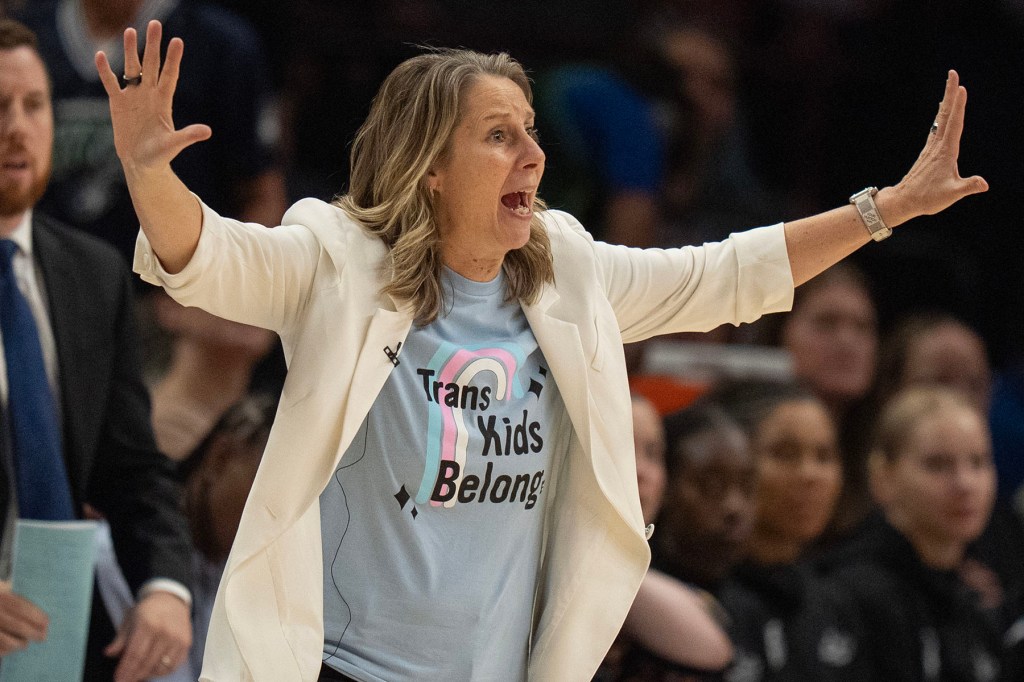
Less than a week later, Minnesota Lynx head coach Cheryl Reeve wore a blue “Trans Kids Belong” t-shirt under her jacket during a game against the Fever in Minneapolis. Reeve told reporters she and Cunningham had spoken ahead of the game, and described the exchange as positive. “We need to protect trans kids,” she said. “To me, it’s a human rights issue. Every kid has a right to sports.”
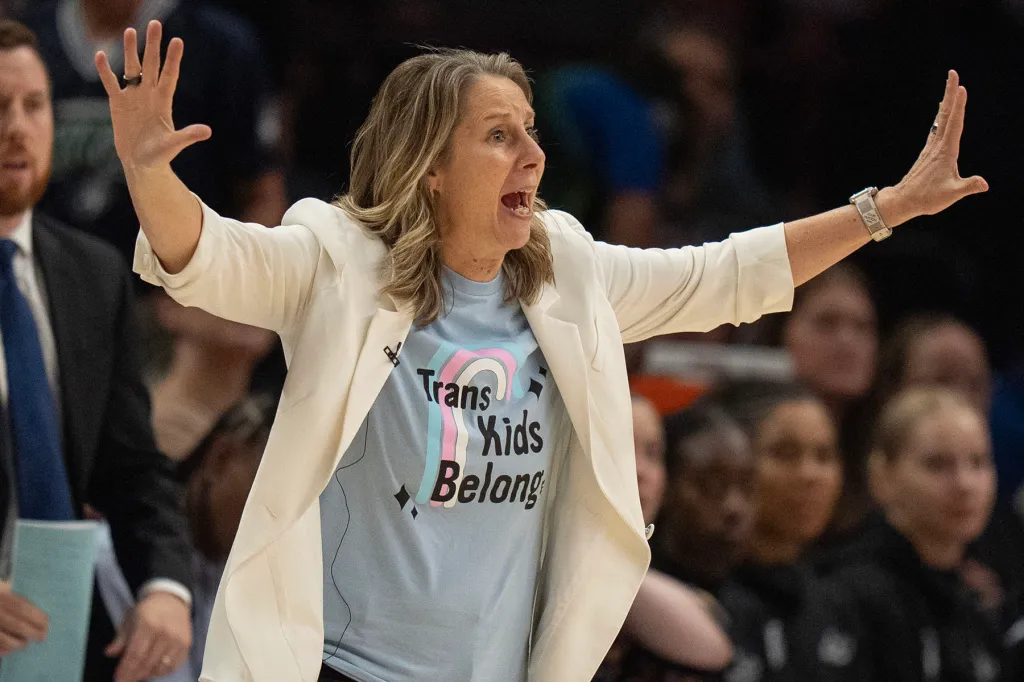
(Jerry Holt/The Minnesota Star Tribune/Getty Images)
There are no out trans women currently competing in the WNBA, and a transgender woman has not played for the league in its entire 30-year history. Layshia Clarendon, who played for 12 seasons, including three with the Fever, is widely recognized as the WNBA’s first trans and nonbinary player. AD Durr, who played for the New York Liberty and the Atlanta Dream before joining the new UpShot League in April, publicly identified as non-cisgender in 2022.
“They are trying to ‘fix’ a problem that does not exist,” Vázquez said of recent discussions surrounding transgender women in professional basketball.
“That’s the thing that’s both fascinating and incredibly demoralizing about where we have arrived in the litigation of trans existence in public,” they said. “A variety of sports leagues have robust trans inclusion policies, and those policies were more than sufficient to cover the realities of trans inclusion in sports.”
Under a collective bargaining agreement reached earlier this year between the WNBA and the Women’s National Basketball Players Association (WNBPA), “only players who are women” are eligible to compete in the league. But the agreement, which runs through 2032, does not explicitly define “women,” an omission criticized in recent weeks by opponents of transgender women in sports.
Citing the agreement, two former NBA players, Enes Kanter Freedom and Royce White, announced this month that they would declare for the 2027 WNBA draft, saying they had met the league’s criteria for eligibility.
Following his announcement, Freedom posted a social media video claiming he would “dominate” the WNBA “without batting an eyelash.”
White, who is under a no-contact order filed by his ex-wife, said he would be “unstoppable” in the women’s league despite playing just three regular-season games during his brief stint in the NBA. He made his announcement days before losing a long-shot Minnesota Senate bid on Tuesday, telling Fox News that he “sometimes” identifies as a woman “for the purpose of basketball.”
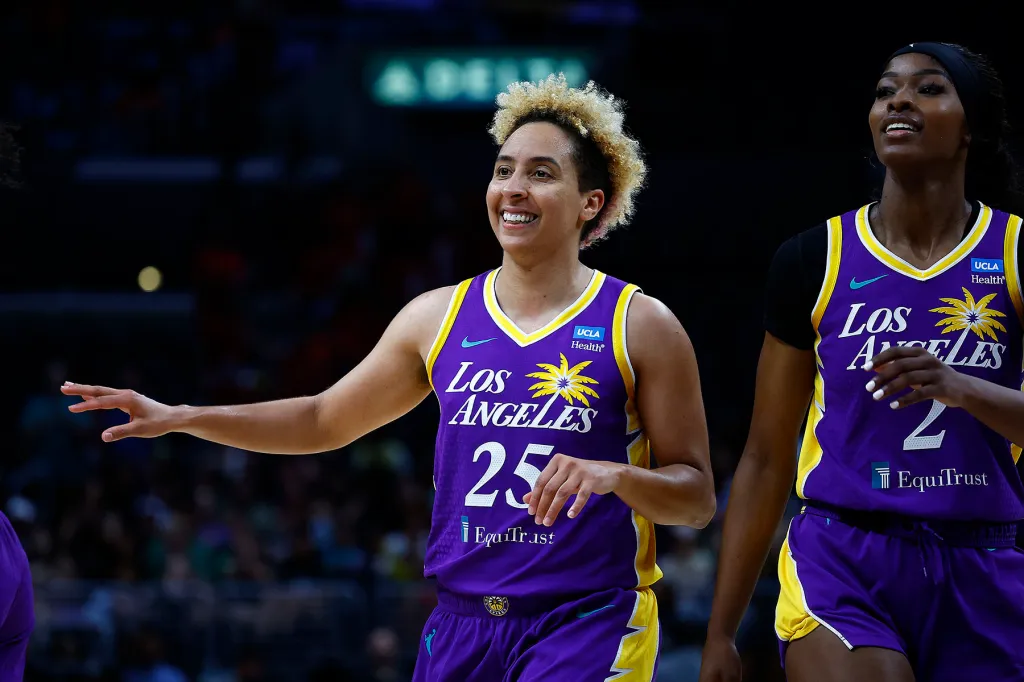
(Ronald Martinez/Getty Images)
Jen Barnes, founder and CEO of Rough & Tumble, one of the nation’s first women’s sports bars, said Freedom’s and White’s declarations for the draft were “absurd” and misogynistic.
“It is incredibly disrespectful to the athletes — the professional elite athletes who play this game,” Barnes said. “There is zero reason to be having this conversation. We don’t even have trans women players in the league right now.”
Barnes, a Washington state native and longtime Storm fan, said she worries that debates surrounding transgender people in the WNBA will make the sport less welcoming for everyone.
“Women’s sports are born from and exist in a space of inclusion. And whether it’s kids, or families who are queer, or women or trans people, the leagues and these teams are supported by an inclusive fan base,” she said. “We see ourselves represented on the court and on the field in women’s sports, and the W and its players have long been an incredibly inclusive space.”
In a statement on August 7, more than two weeks after Cunningham’s original remarks, the WNBPA said its players “will not be used as political pawns,” and that “hate, abuse, and demonization of any person or group of people, including transgender people, only fuel fear, division, and harm.”
The following day, in a memo sent to team presidents, general managers and coaches, the league commissioner, Cathy Engelbert, said the organization would address its eligibility rules Wednesday at a previously scheduled meeting, but stressed that any changes would need to be collectively bargained.
The meeting on Wednesday did not yield any proposed changes to the WNBA’s eligibility rules. In a statement to ESPN, the league said the meeting had covered a range of topics, “including ongoing discussions on transgender athletes.”
“We will approach these important conversations thoughtfully and in alignment with the values of our league,” the statement read. “There are no immediate eligibility matters affecting the WNBA and we strongly denounce the bad-faith efforts to use these topics to demean or marginalize others.”
Katie Hultquist, a Storm fan of more than 25 years, said she appreciated that the players association’s statement emphasized its commitment to diversity and inclusion. “This is a league that has fans of all different kinds of experiences and backgrounds and opinions,” she said. “And that is part of what makes it beautiful, because it’s bringing us together.”
“A very small number of people — probably not actually even fans of the league — are trying to use this opportunity and this issue to divide fans and divide players,” she said.
Hultquist, who works for an international LGBTQ+ nonprofit in the Seattle area, said she’s been encouraged by statements from WNBA players like Gabby Williams of the Golden State Valkyries, who has said she would welcome a transgender player and has spoken out against policies restricting trans rights.
“When we don’t say anything, I think it leaves trans people hanging out to dry with no support,” Hultquist said. “Especially as cis people, I think we need to show that we have their back and that we don’t need to take the bait, so to speak, into bad-faith arguments.”
Nat Pearman, a season ticket holder for the Dallas Wings, said she’s also appreciated how some of her favorite players and coaches have navigated recent national scrutiny surrounding the league.
“Cheryl Reeve is a national treasure,” she said. “She’s very much like, we can have a difference of opinion and actually have a conversation about it. At the same time, we can’t have a conversation if one side sees the existence of trans women as a sort of existential threat.”
Pearman, who is trans and an “OG” WNBA fan of roughly 30 years, said she expects WNBA leadership to “take the path of least resistance” as it eyes a nationwide expansion, but added that the league has a history of player-driven progressive activism.
WNBA players were among the first to affirm the Black Lives Matter movement and protest the rise of police brutality and gun violence in the United States. In 2020, the league and players association launched the WNBA Social Justice Council, a first-of-its-kind effort to address systemic racism, healthcare inequity, gender equality and LGBTQ+ rights.
It was in that same spirit that Chris Paulsen, a 27-year Fever season ticket holder and CEO of IYG, a local LGBTQ+ nonprofit, asked the team’s leadership for a meeting.
The two groups had formed a close partnership over the last decade, she said, and Fever players for years had visited IYG’s headquarters in Indianapolis to meet with queer and trans youth. At the Fever’s annual Pride night in June, the team honored Paulsen, who will retire at the end of the year, at center court.
Paulsen said she met with executive leadership at the Fever and its parent company, Pacers Sports & Entertainment, about Cunningham’s remarks and the ensuing fallout. She asked if they would be open to releasing a joint statement, but they declined, telling Paulsen the Fever is not a political organization.
“I’m just really disappointed in them for not supporting trans people. I thought our partnership was stronger than that,” Paulsen said of the meeting. “But we’re still here. We’ve offered to educate any of their staff about trans girls in sports and things like that. And right now, they’ve chosen not to take that offer, but I’m hoping maybe that will change.”