


The Michigan House race that tests whether ‘only a bro can beat a bro’
LANSING, Michigan – Former Ambassador Bridget Brink has seen her share of tough fights over the past few years.
She was the first woman to lead a U.S. diplomatic mission to an active combat zone as a former chief U.S. envoy to Ukraine. She resigned in protest at the start of President Donald Trump’s second term, moved back to Michigan and launched a run for Congress in a district represented by GOP Rep. Tom Barrett.
But now she’s found herself at the center of a very different kind of fight in her home state: a multi-candidate primary that has turned into a larger existential battle over the future of the party.
Democrats nationally are eyeing central Michigan’s 7th District, which voted for Trump by a margin of just 1 point in 2024, as a top pickup opportunity as they seek to win back the House in November. “This toss-up race will be a referendum on Tom Barrett’s record of broken promises,” Katie Smith, spokesperson for the Democratic Congressional Campaign Committee, said in a statement.
But first, Democrats have to get through a contentious three-way primary between Brink, ex-Navy SEAL Matt Maasdam, and progressive organizer and activist Will Lawrence, one that has become a microcosm of the same dynamics animating Democratic primary races in Michigan and around the country.
“I think this was a sleepy race for a long time,” said Matt Grossman, a professor of political science and director of the Institute of Public Policy and Social Research at Michigan State University, as Brink and Maasdam, both moderates with national security backgrounds, spent much of the race focusing on each other as their chief opponent.
But the last stretch of the campaign has been anything but, he said, arguing both their camps were caught off guard and outside groups have largely failed to make the case that Lawrence’s more left-wing stances are a vulnerability in the general election. “You can tell that no one planned to run against Will Lawrence,” he said.
Democratic voters’ anger toward their party leadership, a rising opposition to data centers and the struggles of establishment-aligned Democrats to consolidate in key primaries have all propelled Lawrence’s late surge in momentum, catapulting him to front-runner status in one recent poll.
Lawrence’s rise has driven outside spending in the race to over $8 million and supercharged the infighting between Brink’s and Maasdam’s camps. It’s been another inflection point in a long-running discussion within the Democratic Party about whether women candidates are unfairly perceived as less electable than men —and it’s inflamed tensions with some Democratic women’s groups who argue that Brink has been unduly underestimated and pushed aside.
In the last week of the campaign, Maasdam’s campaign all but called for Brink to drop out so as to not split the anti-Lawrence vote, a suggestion that infuriated supporters like Jessica Mackler, president of EMILY’s List, a group backing Democratic women supportive of abortion rights.
“The whole situation is really unfortunate,” Mackler told The 19th in an interview on Saturday. “This is something we see over and over again with women candidates: that they are underestimated. And I think the audacity of a man who has been in third place to call, at the 11th hour, for a woman to drop out, it’s really beyond the pale.”
Democrats are aiming to flip multiple Republican-held seats in Michigan. Another EMILY’s List-backed candidate, sex crimes prosecutor Christina Hines, is the frontrunner for the Democratic nomination in the 10th Congressional District, a swing seat in the Detroit suburbs represented by GOP Rep. John James, a candidate for governor.

(Courtesy of Bridget Brink Campaign)
“This is not about moderate or progressive. I’m perfect for this district because I grew up here. I’m raising my family here, and I’m fighting for the issues that people here want,” Hines told The 19th in an interview before going out to canvas in Warren, a major industrial suburb of Detroit.
But in the 7th District, the acrimonious primary threatens Democratic unity going into November. “I think Tom Barrett’s pretty happy,” Grossman said, with the fractured field.
“Democrats are in disarray in Michigan’s 7th Congressional District as their disaster of a primary has turned into a sprint to the far left,” Zach Bannon, spokesperson for the National Republican Congressional Committee, said in a statement to The 19th. “Whichever Democrat escapes the wreckage of infighting at the end of their messy, expensive primary will be resoundingly rejected by commonsense Michiganders this fall.”
There wasn’t a clear frontrunner in the field of first-time candidates for months, though Brink led in endorsements from local officials, fundraising and internal polls as outside groups supporting Maasdam spent millions on ads boosting him and attacking her.
“We women have to work twice as hard and be twice as good to just be considered,” Brink told The 19th in an interview in Lansing after holding a candidate meet-and-greet.
“So from my perspective, I’ve got to put in the hard work. I’ve got to prove myself, and I’m going to deliver for my district,” she said. “And that’s what we did from day one. It’s why we were on the ground meeting with everybody. That’s why my coalition of support is so big.”
Brink, who kept up her campaign while undergoing treatment for Stage 1 breast cancer, argues she’s the only candidate in the state who has successfully stood up to Trump. “Relatable, reliable, resilient and tough,” is how Angela Mathews, a member of the board of trustees at Lansing Community College, described her.
“It’s important to me that in these times that we have someone who’s experienced, and she’s definitely experienced,” Mathews said. “I like that she has been in the trenches. I like that she’s been in a war zone, which is a very difficult spot to be in.”
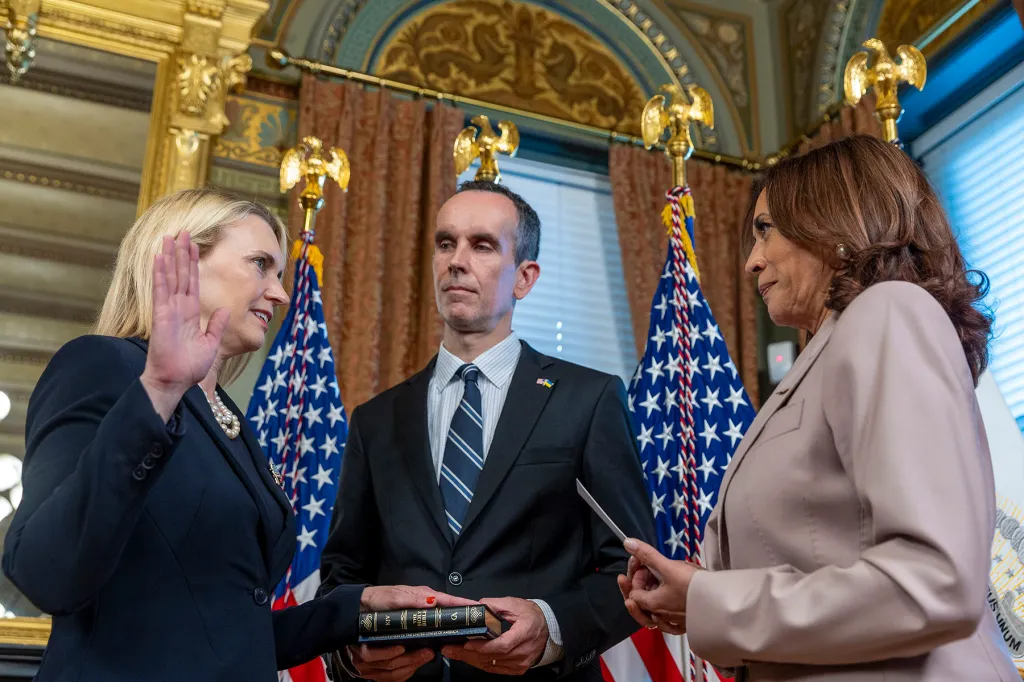
(Tasos Katopodis/Getty Images)
That message resonates with supporters Tom and Carol Nicholas, who also attended the meet and greet. “I want to keep electing the women,” Carol Nicholas said. But for them and all Democratic voters who spoke to The 19th, defeating Barrett is their top priority.
“I don’t think there’s a bad choice among the three,” Tom Nicholas said.
Another prominent Michigan Democrat further shook up the race by backing one of Brink’s opponents: Sen. Elissa Slotkin, who formerly represented the district in the House, endorsed Maasdam in an effort to boost him out of third place.
Slotkin’s endorsement rankled some Democratic women who were upset with her not backing Brink, another woman candidate with a background in national security, Axios reported in July.
Josh Stewart, a spokesperson for Slotkin, said in a statement to the outlet that she was “singularly focused” on flipping her old seat.
“If Dems care about winning, they should unify around Maasdam with the same energy as the GOP is expending to see him lose,” he wrote on X.
Electability has been a central message for Maasdam, who spent 20 years as a Navy SEAL before serving as a military aide to former President Barack Obama — his job responsibilities included carrying the nuclear football.
Maasdam also pointed to a last-ditch effort from a PAC with ties to Republicans that has spent $1.2 million boosting Lawrence and opposing him as proof he’s most electable.
“It’s unfortunate to see Republicans playing in a Democratic primary, and it’s not something I want to see,” he said. “That said, I think their guns are trained on me because they see me as a threat, and they’re scared to face me in the fall.”
He said the same of some $300,000 in spending opposing him from Elect Democratic Women and the EMILY’s List’s affiliated super PAC Women Vote, which are supporting Brink. “I feel like it’s a bit of an honor,” Maasdam said.

(Courtesy of the Matt Maasdam Campaign)
That experience, he said, “neutralizes” the political benefit of Barrett’s veteran status.
“You’ve laid your life potentially on the line for the country, and I think that’s rewarded in this district,” he told The 19th in an interview after a candidate meet-and-greet. “I think service is service, so I applaud Bridget’s service. I actually applaud Tom Barrett’s service — I just don’t think Tom is a great congressman.”
Slotkin’s endorsement swayed at least one voter: a woman named Maria, who asked only to be identified by her first name, is a Republican but came to a Maasdam meet-and-greet after seeing that Slotkin backed him. “I don’t like the other two,” she said.
“I want a role model for my son,” said another voter, Kirsten Thompson, who said she appreciated Maasdam modeling a healthy version of masculinity as an ex-Navy SEAL who exemplifies “knowing when to be tough and when to be soft.”
Electability was top of mind for voters like Toni Glasscoe, a member of the Grand Ledge School Board, who said Maasdam is “a man of integrity.”
“It’s got to be the long race,” she said. “We have excellent choices, and there’s a lot at stake.”
And after a poll commissioned by a pro-Maasdam group and released last week showed Lawrence leading the field with 38 percent of the vote with Maasdam in second, Maasdam’s campaign said the poll shows Brink’s “only role” in the race is to “play spoiler” despite her lead in fundraising, endorsements and in most publicly-released internal polling.
Another Brink supporter, state Sen. Sam Singh, objected in a Facebook post.
“The idea that the highly qualified female candidate that has raised the most amount of money and had led in polling should step down for the guy in third place is beyond me,” he said.
The idea that Brink should clear the way for Maasdam pointed at a problematic way of thinking, Singh wrote. He dubbed the argument: “Only a Bro can beat a Bro.”

(Pete Souza/The White House; Courtesy of the Matt Maasdam Campaign)
Meanwhile, Lawrence, an original co-founder of the climate activist group Sunrise Movement, has been gaining steam with a grassroots campaign.
On a Sunday afternoon, The 19th found Lawrence seated at a desk on the sidewalk outside a coffee shop where for three hours, he sat next to a whiteboard that read “Hire Will Lawrence,” conducting 10- to 15-minute interviews with voters.
“I’ve built my campaign on a very simple premise, which is not ideological,” he said. “It’s about being from here, being accountable to the people of this district, showing up to be accessible to the people of the district, like we’re doing here today, because people are tired of just being talked to by their elected officials.”
Progressive insurgents have won key House primaries in safe blue seats, but Lawrence would be the first to win a primary in a swing seat like Michigan’s 7th District. Three super PACs have spent nearly $2 million on ads against Lawrence as he’s gained traction in the polls. Much of the negative advertising has focused on comments he made on a 2024 podcast episode criticizing senior Black establishment lawmakers as standing in the way of progressive policies.
On July 28, he walked 12 miles through Lansing, ending at a rally and canvassing launch with progressive U.S. Senate candidate Abdul El-Sayed and other national progressive surrogates.
Lawrence has also highlighted that, unlike his rivals, he’s a native of the district and has strong local ties through years as a local organizer. Kathy Yates, a Lawrence supporter who attended the rally, said she knew his wife through a class on anti-racism they both took. Nichole Keway Biber, a tribal citizen of the Little Traverse Bay Band of Odawa Indians and an environmental activist, said she’s known Lawrence for a decade since his early days at the Sunrise Movement.
“I have not seen this community as excited as it is for Will for anybody else in a long time,” said state Rep. Emily Dievendorf. “It is cross-generational and it really touches every demographic.”

(Rosem Morton for The 19th)
Even before launching his campaign for Congress, Lawrence has been involved in a burgeoning local activist movement opposing new data center construction, one that cuts across party lines.
“People really effing hate data centers,” El-Sayed told reporters after the canvassing launch.
“This is uniting people across the political spectrum because they feel it as a real attack on the basic principles of democracy and self-determination,” Lawrence said, adding that his team did an experiment knocking doors of lower-propensity Republican voters and, in one afternoon, found two-time Trump voters and a registered Republican woman who were voting for him after seeing his TV ad on the issue.
Sunrise Movement activists disrupted an event Trump held in the district at the General Motors Milford Proving Grounds where Barrett also spoke on July 27. And at least twice during Brink’s meet-and-greet in Lansing, including once as The 19th was in the midst of interviewing her, young activists interjected and filmed Brink while pressing her on her stance on data centers and Israel’s war in Gaza.
For Brink, the issues in the race are personal — as a cancer survivor, she says she hears other voters’ stories of struggling with health care costs on the trail. And to her, the stakes of the race strike not only at the heart of the Democratic Party, but of American democracy itself.
“I’ve lived in these countries where young democracies are trying really hard to maintain freedoms and rights and the rule of law, and they’re discouraged because it’s very hard,” she said. “I never thought our own country would be one that would be at risk, and that’s what we face now.”