

‘She never retreated’: Women of color say Gloria Steinem leaves a legacy of inclusive feminism
Illinois Lt. Gov. Juliana Stratton got Gloria Steinem’s endorsement in her bid for U.S. Senate. But that’s not what matters to her about the feminist icon, who died this week at the age of 92.
“She inspired me not just because of what she did that was so very public and out front and trailblazing and history-making and all of those things, but in the many small ways that she encouraged women like me behind the scenes,” said Stratton, who won the Democratic nomination for an Illinois Senate seat. “She was someone who strongly, first of all, believed in women supporting women, and it didn’t just mean, ‘Well and I’m going to endorse you,’ or ‘I’m going to have an event for you,” though she did those things for me in this run for United States Senate. But it’s the notes. It’s the text message that’s encouraging. It’s the willingness to open her home and gather us together to talk about why it’s so important for women to do this together.”
Stratton, who would be the sixth Black woman senator, said Steinem recognized Black women’s place in the feminist movement, including in electoral politics — from Shirley Chisholm, whose 1972 presidential campaign Steinem championed, to Carol Moseley Braun, the first Black woman senator, who was elected in Illinois in 1992 as a Democrat, to Kamala Harris in the 2024 presidential election.
“When Black women didn’t feel that their voices were always included, honored and respected, I think one of the things that Gloria Steinem came to represent and recognize is that we have to do this together, we have to fight for all women,” Stratton said.
Reflecting on Steinem’s leadership, Stratton said she sees the decades of work toward true equality and “unfinished business.”
“I hope to continue the work, the groundwork, that she’s laid. The incredible legacy that she left behind is not for us to just look at it and say, ‘Wow, wasn’t she a great woman?’ I’m not sure she would have cared about that. I think what she would want is for all of us to say, ‘OK, Gloria — I’m taking the baton from you. I’ve got it from here. I’m going to keep running with it.’”
Moseley Braun wrote in her memoir, which came out this year, about the impact Steinem had on her path to the U.S. Senate, starting when she stopped by her campaign headquarters at a time when cash was tight.
“Her appearance felt like a miracle,” Moseley Braun recalled. The two went out to meet voters on a cold Chicago day, and Steinem, she said, became an important voice in the diverse coalition that helped elect her. “That day represented a turning point in the campaign.”
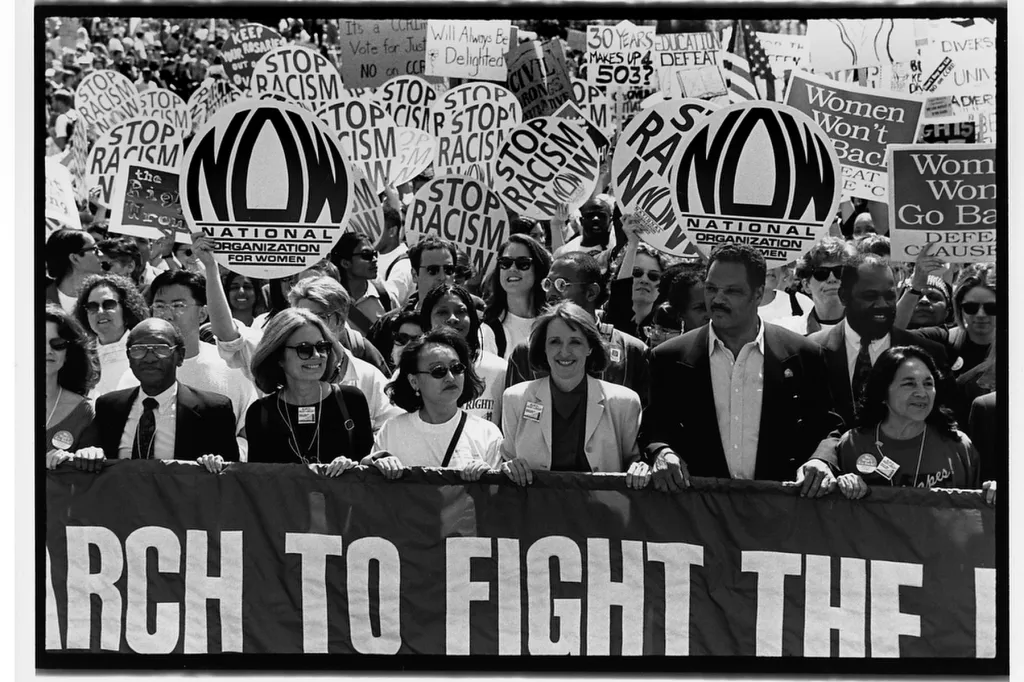
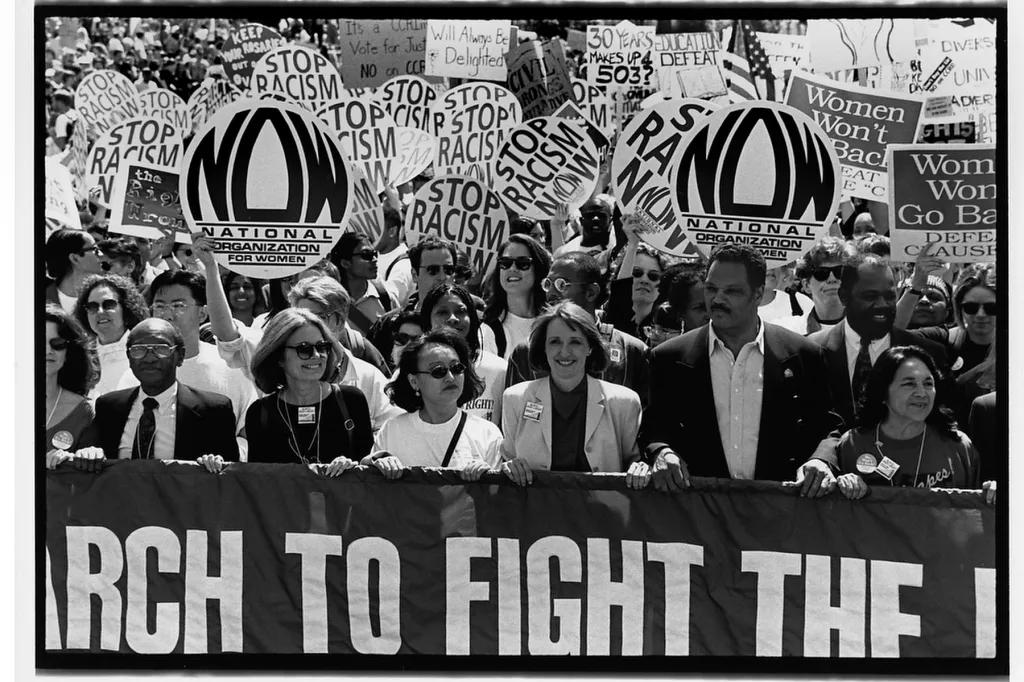
Steinem leaves a legacy as a feminist icon who fought for gender equity through the end of her life. But critically, it also includes linking arms and elevating Black women’s voices and Black women leaders, sometimes in the face of criticism, and speaking up about the ongoing task of making feminist work more inclusive. She made the case for intersectional feminism and for the fight for racial equality in New York magazine in 1969, in a popular article headlined “After Black Power, Women’s Liberation,” and continued that work throughout her life. Many women of color who have fought for civil rights say that her view on feminism was shaped in part by the women of color around her, and that throughout her life, she worked to elevate women of color into positions of power.
(Jenny Warburg)
“Early on, she understood that the legal and political fights, the policy fights, that we were having, they were really cultural conversations around who we were as a country, and she leaned in,” said Fatima Goss Graces, president and CEO of the National Women’s Law Center.
Steinem was someone “who often spoke very deliberately to the relationships between different types of women and she spoke about what it looks like to create intentional solidarity,” Goss Graves said. “She named both a historical and present-day effort to leave Black women out, even though they were the fuel of so many of our movements and so much of our politics.”
Goss Graves said Steinem deeply studied the suffrage movement — and learned from it the value of building coalition with Black women, whose efforts and aspirations had been cast aside generations earlier.
“She talked a lot about the mistakes that were made all around and that when the suffrage movement and abolition movement worked together in solidarity, they were more powerful. And when they were divided, those divisions were exploited and they were less powerful. She was a student of that history and worked to implement it in real time.”
Alexis McGill Johnson, the president and CEO of Planned Parenthood, said that in processing Steinem’s legacy, she is thinking about the relentless way in which she was working to build a better, more inclusive movement.
“She never retreated. She continued to live the same kind of powerful life with the same powerful practices that are hard work to do. But I think she really saw the power of the movement as being multi-generational and inclusive and interdisciplinary,” McGill Johnson said. “She was doing [talking] circles all the way to the end and, as far as I could see, really bringing together rich, diverse communities.”
Steinem left a country that remains very much hostile to women, particularly women of color. She never saw a woman lead the United States as president despite backing the campaigns of both Hillary Clinton in 2016 and Harris. Goss Graves and McGill Johnson both noted that Steinem died the same week that some of the nation’s most prominent Black women leaders faced overtly racist and misogynistic attacks by conservative provocateur Laura Loomer, an adviser to President Donald Trump.
“I’m clear about the context we are working in, where we have lost fundamental rights and we are dealing with a really powerful coordinated effort,” Goss Graves said. “But I think the lesson from Gloria is how much power there is in gathering and energizing women, in telling the story of not only what the extremists are trying to do, but the fact that there’s a better vision around the corner if we fight for it.”
McGill Johnson said the targeting of Black women leaders points to where the movement needs to focus its efforts.
“It’s not just that Gloria Steinem was inclusive for what inclusivity meant in her time and her ability to move it forward. It’s how do we move from that framework to one where we are unapologetic about saying, ‘We’re not going to get liberation until Black women are free,’” she said. “That’s a place where I believe she was also leading — leading from behind, leading in support from many leaders and I know this from many conversations that I had in her rooms.”
Steinem’s work wasn’t without criticism from fellow feminist leaders. The Black feminist writer and thinker bell hooks, in her book “Ain’t I a Woman,” described Ms. magazine as a product for White women, and criticized Steinem for taking a “narrowminded, and racist” view on the work required to understand Black women’s experiences.
(Jenny Warburg)
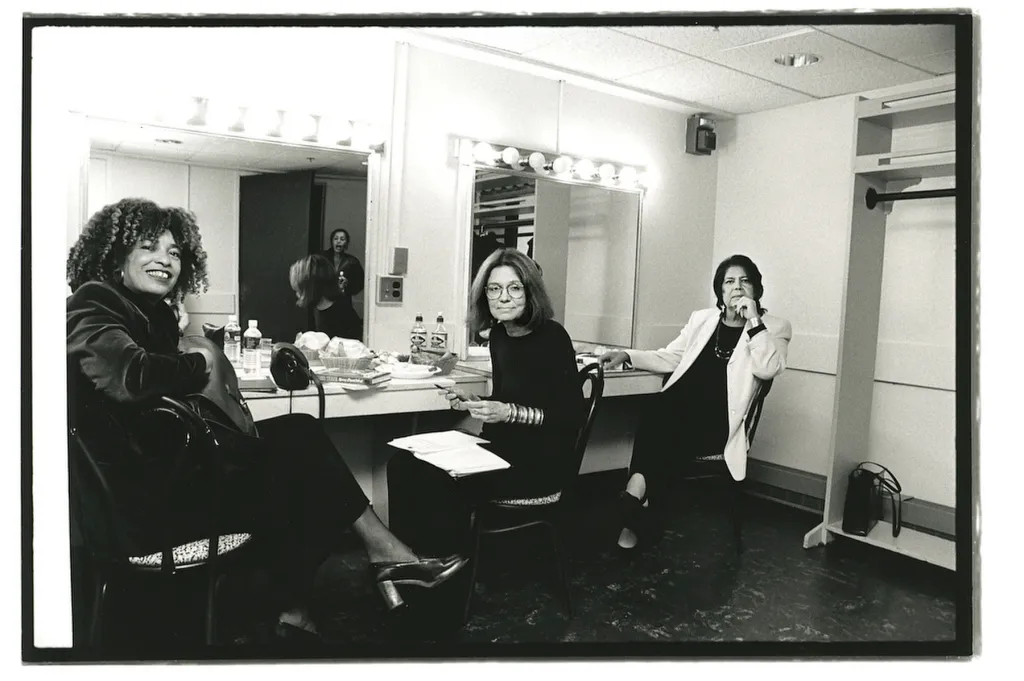
Steinem and hooks nevertheless maintained a warm relationship for decades, and their public conversations on the issue illustrated Steinem’s ongoing preoccupation with building a feminist movement and society that was more gender and racially inclusive.
In a conversation with hooks at Eugene Lang College in 2014, hooks described the time as a “chaotic moment for feminism globally,” in part because of tensions between feminism and racism.
“One thing I can say about her, from the moment I met her, I saw that she lived the practice of anti-racism,” hooks said. “A lot of White women within feminism would talk about racism, but what they actually did in their lives… It’s like the White people you know who are so progressive but then they don’t have any Black people in their lives.
“That’s not Gloria Steinem.”
Steinem’s dedication to the movement she spent her life building included championing and uplifting a diverse cadre of younger women who would carry the work forward. Sometimes that work was intimate — fostering conversations at the intersection of race and gender at her own home.
Reshma Saujani said she felt “mentored and lifted up by Gloria” throughout her career, first as the founder of Girls Who Code and in her current work as the founder and CEO of Moms First.
She last saw Steinem on July 7, when Steinem hosted a talking circle in her home for some of the Moms First “super moms” for a screening of the group’s new documentary, “No Country for Mothers.”
“She just sat in that room as we talked about how complicated motherhood is, how motherhood isn’t designed for America, how America doesn’t make it possible for you to both mother and work. I think she believed that, in many ways, motherhood was the unfinished business of feminism and her work.”
She noted that Steinem continued to host conversations among women, largely women of color, into her 90s. “Think about what kind of legacy that is — to commit to opening up your home and your space in the last years of your life to make sure that women had space and that women could build community.”
Goss Graves pointed to the way that Steinem actively cultivated relationships with those younger than her as a critical dynamic in this intersectional community-building.
“She had close friendships with very young feminist leaders, up to folks who she came up with. A lot of folks are talking about her talking circles and it’s hard to describe how magical they were, but they always included sets of women across generations and I think that helps. That helps you evolve,” Goss Graves said. “If you see yourself as in shared company, community and strategy with women coming from different perspectives, that’s going to help.”
Synclaire Warren, 25, first met Steinem when she was invited to a talking circle about menstrual health at Steinem’s. Warren is a feminist writer, researcher and content creator, working on social media as Your Local Feminist Fairy.
“We were talking about different people in the space as well as Indigenous practices with menstrual health, how it’s really been shamed even though it’s just a natural, biological process. And she was just the kindest person I had ever met,” Warren said. “Gloria — anyone who can read about her can see how much she includes every type of woman, every type of person into this movement.”
Warren said Steinem’s commitment to being surrounded by a diverse group of voices at all times and to making sure young women of color could continue to lead in activist spaces was notable to her. Steinem nominated Warren to be one of Culture Mag’s annual Young Activists last year.
“Just having someone like her see me for all the work I am doing — I have imposter syndrome, especially being a woman of color, Black and Filipina,” Warren said. “I have always wanted to be a part of feminist work and feeling often that I didn’t know how to contribute, or feeling like my work is just a molehill against mountains — it really has been the most incredible thing of my life to work with her. She is such an example of how we can go forward in impossible circumstances and be more connected and more inclusive and listen to others, bring other people up.”