

How Rosa Parks’ legacy inspired a new fight over who could ride the bus
Decades after her act of defiance, Rosa Parks galvanized a cadre of activists to protest their own conditions and, though the scope of her legacy for them is still coming into focus, it remains just as powerful.
They were fighting for disability access, and, like Parks, they used public transportation as a springboard.
The disability rights movement took shape against the backdrop of the Civil Rights Movement in the 1960s, growing in size with each passing year. By the 1980s, it had made strides, successfully passing legislation and increasing the visibility of people living with disabilities.
But on roads and rails, small advances made in bus accessibility throughout the years did little to meet the needs of commuters with disabilities, whose use of public transportation was severely limited. Oftentimes, they were relegated to using separate services entirely, relying on transit services such as Dial-a-Ride, which required passengers to request a pickup and were frequently unreliable.
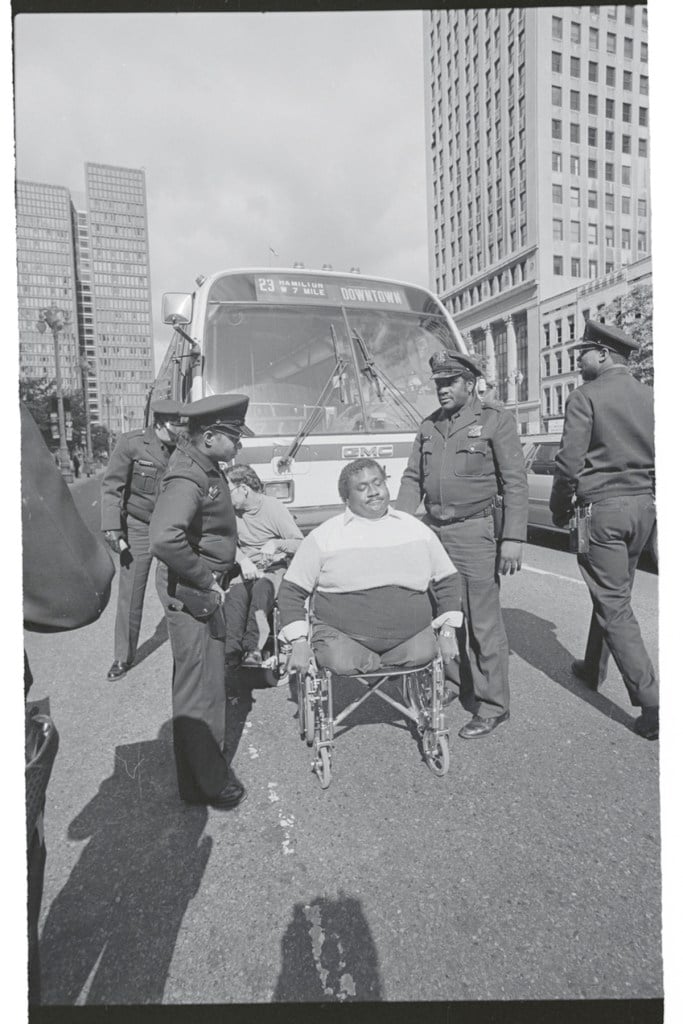
In 1984, something changed. In Chicago, about a dozen wheelchair-bound activists from the disability rights group ADAPT placed themselves in front of city buses to protest the Chicago Transit Authority’s decision to purchase more than 350 buses — none of which were accessible to them due to the city’s refusal to pay for wheelchair lifts.
The demonstration was reminiscent of Parks’ own protest that had taken place more than 700 miles south and nearly 30 years prior, when she refused to vacate her seat for a White passenger. As law enforcement officers arrived at the scene, a single sentence was emblazoned on each of the protesters’ name tags: “My name is Rosa Parks.”
“We used a lot of the tactics that were used by Dr. King and Gandhi and we were inspired by the fact that Rosa Parks as a Black woman couldn’t even really sit at the front of the bus and those of us who use wheelchairs couldn’t even get on the bus,” said Anita Cameron, director of minority outreach at Not Dead Yet, a disability rights group. Cameron has volunteered at ADAPT and worked in transportation advocacy for several decades.
ADAPT’s own relationship with Parks was complex. Years after that fateful protest in Chicago, she was invited to join an event with the organization in Detroit, an offer she declined.

(Bettmann Archive/Getty Images)
“We tried to get Rosa Parks to join us and she wasn’t able to and that upset a lot of people,” said Cameron. “Didn’t upset me because I felt that Rosa Parks had already done her thing, done great things… You know, as a Black disabled woman, I certainly couldn’t get upset with Rosa Parks, get upset with another Black woman who paid her dues and went through what she went through.”
Still, Parks’ influence was crucial in the disability rights movement.
The Chicago protest kicked off a years-long battle for disability rights. After a flurry of legislation, formal complaints and more demonstrations around the country, it eventually culminated in the passage of the Americans with Disabilities Act (ADA) in 1990.
A lot of the work and belief that it’s possible comes from the civil rights movement and individuals like Rosa Parks.”
Anita Cameron
“It’s interesting because Rosa Parks is mostly known as a civil rights activist and the act of civil disobedience and kind of her advocacy around segregation, racial segregation on buses and transportation,” said Alex Elegudin, who co-founded Wheeling Forward, an advocacy organization for people with disabilities. “It’s amazing how that has both inspired and morphed and kind of led future work by disability advocates.”
In the years that followed Parks’ protest, other movements including the LGBTQ+ rights movement made their own progress — an achievement for which Elegudin also gives credit to Parks.
“A lot of the work and belief that it’s possible comes from the civil rights movement and individuals like Rosa Parks,” he said.
As the country moves away from the progressive measures that people like Parks set in motion, Cameron shared that those living with disabilities will be monumentally harmed. “I mean our rights aren’t just being stripped away,” she said. “They’re potentially going to be replaced with extraordinarily repressive, oppressive measures — some measures, which may wind a lot of us disabled dead.”
When Cameron was born, the Voting Rights Act had not yet been passed and people living with disabilities were not able to get an education. As she came of age and was inspired by figures like Parks, she became heavily involved in disability advocacy.
“As a Black person, as someone who’s disabled, I look at the things that Rosa Parks did and the fight that she fought and I’m especially grateful because we are losing,” she said.
The very rights she once fought for are slowly being taken away.
“I have lived through enough history,” she said. “I took part in the fight for the ADA. I took part in the Capitol crawl, the rotunda takeover, took part in the fight for Medicaid back in 2017 and whatnot. I can’t tell you how many times I’ve chained myself to the White House fence and been arrested at the White House during Democrat and Republican administrations fighting for disability rights…. And to see that go away — it’s extraordinarily scary. But we have to still keep fighting.”
Her courage inspired us.”
Anita Cameron
For her, Parks’ influence on the disability rights movement and the Civil Rights Movement is a paradigm for civil disobedience and it’s one she hopes to continue.
“Her courage inspired us,” she said. “Rosa Parks could do what she did in a time when Black folks had no rights. We disabled could do this at a time where we at least had minimal human rights.”
As she moves forward, Cameron hopes to continue to share the importance of Parks’ life. “I can do nothing but honor her as an ancestor and honor her memory.”