National park signs on women and LGBTQ+ history are disappearing. Librarians are preserving the record
Jenny McBurney, a librarian specializing in government publications, was in Washington, D.C., in June when she heard the news that the Department of Interior, the agency responsible for overseeing the national park system, had produced a spreadsheet listing dozens of sites where it had removed materials deemed disparaging to Americans or unrelated to the beauty and grandeur of our national parks.
She and other people who happened to be in town for a convening about the importance of public history in telling the complete American story, decided to visit some of the places on the spreadsheet to see exactly what had been modified in the nation’s capital.
“We were calling it our little sign quest,” quipped McBurney. “We were going to go, and you know, hunt down as many as we can.”
One of the stops was the Belmont-Paul Women’s Equality National Monument, designated by the Obama administration in 2016 to honor the National Woman’s Party, which fought for women’s equality and was founded by suffragettes Alice Paul and Lucy Burns.
McBurney helped inspect the informational plaques outside the brick building until they found what they had been looking for: a recent alteration on a sign describing some of the tactics used by suffragists to fight for the right to vote.
A 2025 photo of the plaque shows the sign stating that after women were imprisoned for a protest outside of the White House in 1917, they were “beaten and force-fed when they went on hunger strikes.”
The sign now reads: “The women, many of whom came from prominent and politically connected families, demanded to be treated as political prisoners.”
The new placard also leaves out a reference that this was a turning point that helped change public opinion on women’s suffrage. In other words, they are “removing the fact that that action worked,” McBurney said.
The 19th has contacted both the National Park Service and the Department of Interior to comment about this and other removals at national park sites and did not receive a response.
The changes were alarming to Burney, who, the year before, had co-founded an organization with public historians and other women librarians called Save Our Signs. Its goal is to create a crowdsourced historical record of information signs at national park sites, in the event they are changed under the Trump administration.
“If people go to these sites and expect to see the full history, and they’re not seeing that, then that is a missed opportunity for so many people,” said McBurney. “Especially with the quiet changes on the signs where you can’t even tell that something’s been changed. They think that they’re hearing the whole story, but they’re not, and that’s not fair to them.”
The women behind Save Our Signs sprang into action after Interior Secretary Doug Burgum directed public lands officials to flag any materials that “are negative about either past or living Americans or that fail to emphasize the beauty, grandeur, and abundance of landscapes and other natural features.” Burgum issued the directive in May 2025 to help Trump fulfill his executive order, titled “Restoring Truth and Sanity to American History” and aimed at weeding out facts the administration says are driven by ideology and spreading divisiveness.
The organization now maintains an online archive of photos of information signs at national parks as a way to preserve history.
Since that announcement, signs talking about slavery and Native American history have been removed or revised and references to climate change have been taken out of several parks. Caught up in these revisions and erasures are also the lived experiences of women and LGBTQ+ people and the roles they played in American history.
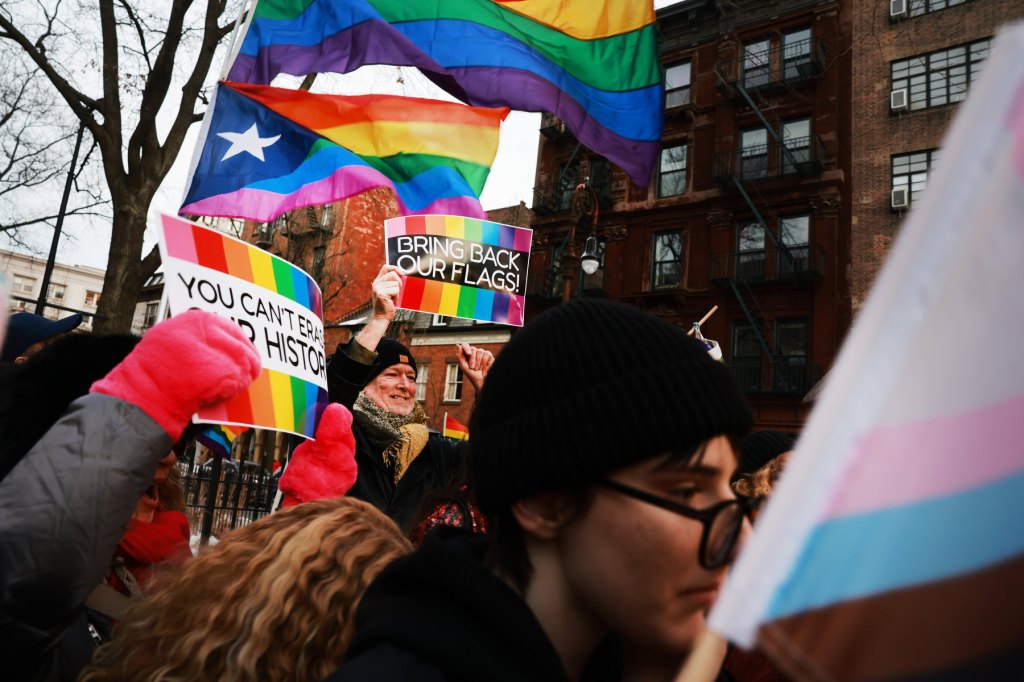
(Spencer Platt/Getty Images)
Some of the signs removed or rewritten reference violence against women. One example is the language under a sculpture of the Civil War soldier and explorer Gustavus Cheyney Doane in Grand Teton National Park, in Wyoming describing his participation in a massacre of predominantly women, children and elders from a band of the Blackfeet Tribe that was removed.
At Philadelphia’s Independence National Historic Park, a focal point of the Trump administration ahead of the country’s 250th anniversary, panels describing the lives of people enslaved under George Washington have been replaced with what advocates have called a sanitized, whitewashed version of history. Lost were descriptions of violence that detailed the horrors enslaved women faced, including sexual violence and family separation.
What the administration is choosing to erase from history raises a larger question, said Molly Blake, a librarian and co-founder of Save Our Signs. “It’s instructive that this administration has chosen this as a fight, that they don’t want any reference to anything violent that happened in history, that they don’t want references to people abusing power in history. They don’t want references to even the existence of certain communities in history,” she said. “That always begs the question of why are they doing that? Why is that such a threat?”
Other signs reference women’s contributions. As first reported by The 19th last year, signs at Muir Woods National Monument were altered in California, including those stating that women played an important role in the monument’s conservation history. At Lowell National Historical Park in Massachusetts, films that delved into the history of immigrant workers and honored the “mill girls,” or women who worked in the textile mills and whose fight for labor rights helped shape modern workplace protections, were removed. Democratic Sen. Ed Markey has since published the video on his YouTube page.
The National Parks Conservation Association (NPCA) is part of a lawsuit challenging the removal of history in the parks. Its northeast regional director, Kristen Sykes, wants to see those videos returned to the visitor center and shown in their entirety so that visitors can have a full understanding of the lives of the people who worked there.
Sykes said it’s not just signs and films that have been a target of the order; it’s maps, social media posts, books and brochures. “It runs the gamut,” she said. There is also the fear that new changes and historical additions might not ever make it into the parks under the Trump administration if it conflicts with his order. “The interpretation and content that’s distributed by the parks is often reviewed in Washington,” she said. “So there are things that have been taken down, and there is also information that maybe hasn’t been publicized.”
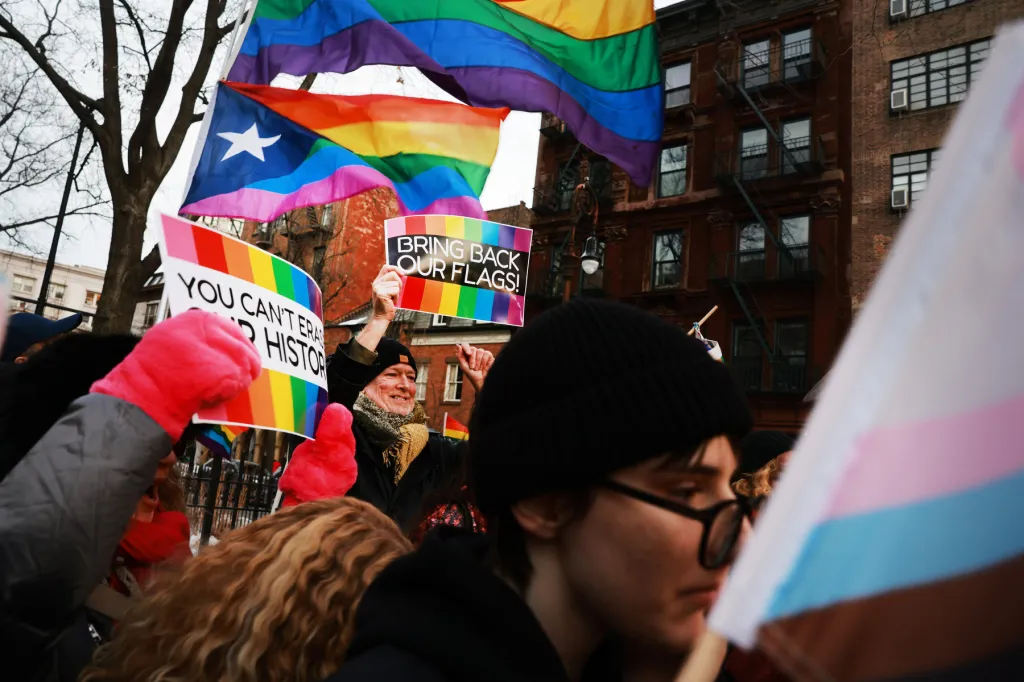
The changes occurring at the parks have also affected the LGBTQ+ community. In February 2025, the National Park Service deleted references to trans people from the Stonewall National Monument’s website and took down a Pride flag that hung outside of the building in New York, an important site for LGBTQ+ activism in the 1960s. The changes had been made to meet the directive of a different executive order aimed at eradicating “gender ideology extremism.” After a legal battle, the flag returned to the monument, but the website continues to refer to the LGBTQ+ movement as the LGB movement. An article written for the national monument’s website about the role trans and queer people played in the Stonewall Riot was also taken down.
At Sunset Crater Volcano National Monument in Arizona, a sign that included a photo of a visitor holding a small Pride flag was reportedly taken down, according to the lawsuit filed by Democracy Forward, on behalf of NPCA and other organizations.
Advocates are worried more could disappear. While a legal challenge temporarily paused the removal of items from the parks in June, a federal appeals court ruled a month later the administration could continue its efforts.
Over 500 items have been referred by National Park Service officials to the Department of Interior for review, according to a leaked database The Washington Post reported on in March. These included a book about Black women, nonbinary and gender nonconforming people in nature at Yosemite National Park; a site bulletin about Emmett Till and the fight for civil rights waged by his mother, Mamie Till-Mobley, after his death; a book about women soldiers in the Civil War at Fort Donelson National Battlefield in Tennessee; and images that depict the torture of enslaved women at the Timucuan Ecological & Historic Preserve in Florida.
At the Castillo de San Marcos National Monument in Florida, the back cover of a book was flagged for commenting on the “shockingly late ratification of the 19th Amendment guaranteeing women’s suffrage.” At Cape Hatteras National Seashore in North Carolina, a junior ranger book was reviewed for “appropriateness” for stating that some women pirates disguised themselves as men.
For Antoinette Burton, a historian and professor at the University of Illinois, the changes feel somewhat random — either very broad in scope or very subtle. That has made her wonder who exactly is behind the changes and what methodology they are using to determine what to scrub and what to keep. “How does it all get operationalized?” she asked. “That would be important to know because if they’re doing the administration’s work, why don’t we know who they are?”
She sees the changes in the parks as part of an ongoing struggle to interpret history. “We have to shine a light on what this is doing and have a reckoning about what it means and for whom,” she said.
Long before the efforts by the Obama and Biden presidencies to diversify historic perspectives, which the Trump administration has decried as “woke ideology,” historians had been challenging the collective understanding of whose stories should be told and expanding the historical record to include the stories of women, LGBTQ+ people and communities of color.
To Burton, dialing back those efforts reinforces the idea that these narratives actually matter. “They drive people’s identity and self-representation and conviction about the world,” she said. “One set of arguments has been ascendant in the last 50 years, and the current regime is determined to push that back into the darkness.”