

Trump Accounts could benefit kids. But can they access them?
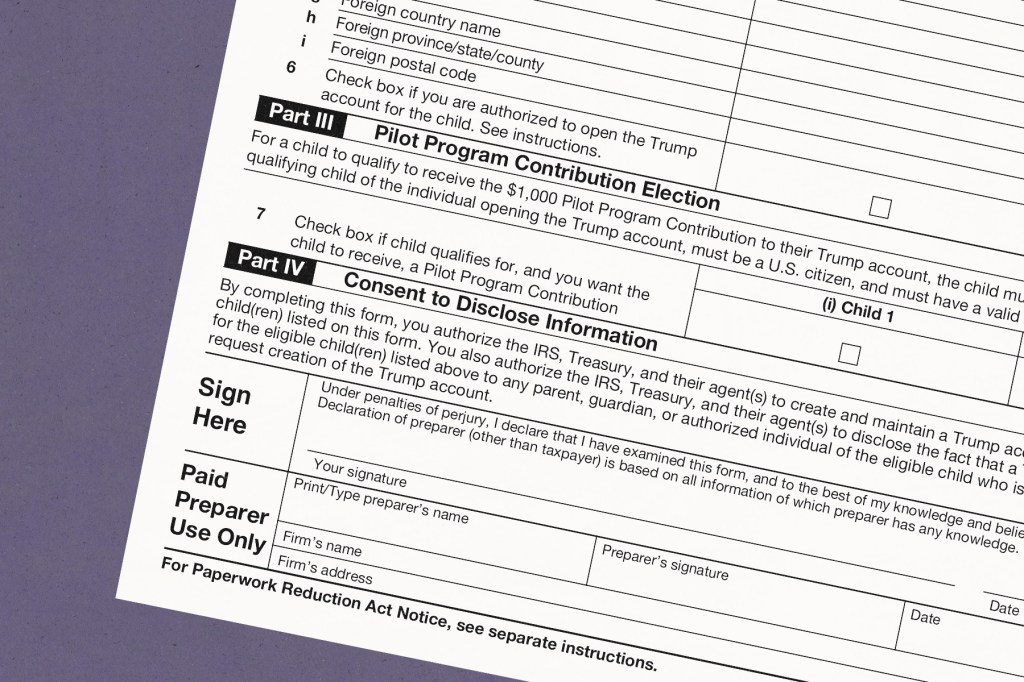
Trinity Coleman of Boones Mill, Virginia, gave birth to twins in May 2025. Under a new program created by 2025’s One Big, Beautiful Bill Act, each of Coleman’s babies is entitled to $1,000 in a tax-deferred savings account through the federal government. That $1,000 would be invested in the stock market and grow throughout their childhoods.
Yet, until a former coworker mentioned it to her, Coleman wasn’t aware of the existence of the program. And unless Coleman registers the twins for the so-called Trump Accounts and requests the money through the IRS, they will never see that money.
Coleman said it was frustrating to think she might have missed this opportunity for her kids. “If it would help them as adults, that’s all I would want for them,” said Coleman.
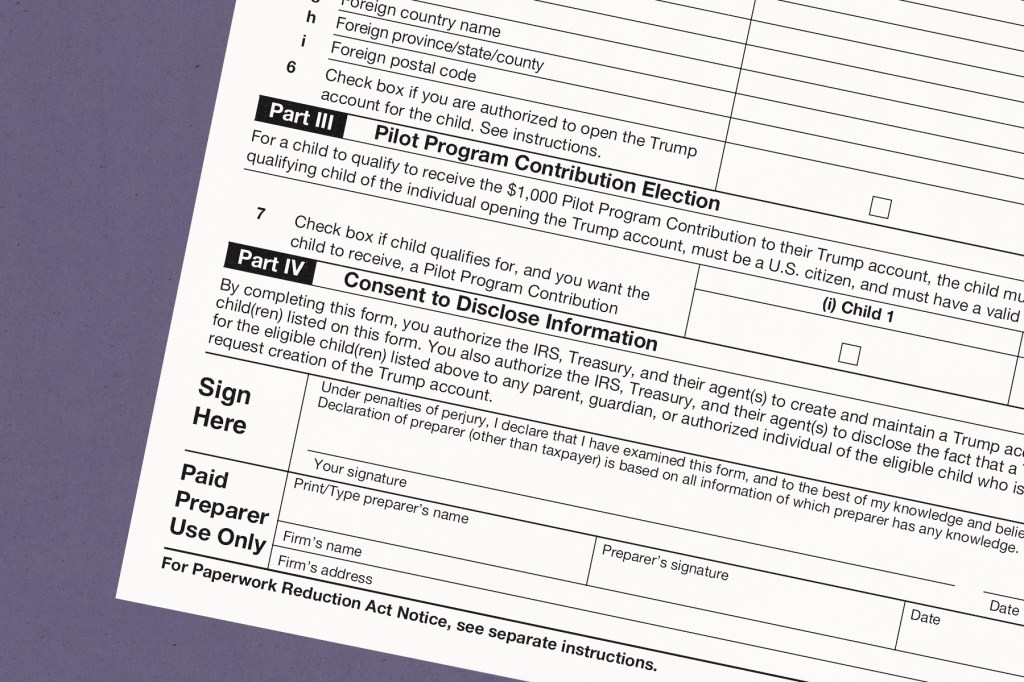
Trump Accounts launched on July 4. But a portion of the billions of dollars now marked for them may go unspent due to one aspect of the program: enrollment is not automatic. A child’s parents must enroll each of their qualifying children in the program, and then opt in to receive the seed money. Many Americans learned about the opportunity while filing their taxes. Some tax-filing software, like TurboTax, asked 2025 tax filers if they wanted to enroll. But not everyone files their own taxes or even files at all. According to an analysis released by the U.S. Treasury Department in June, about 5.5 million children have been registered for accounts, 1.4 million of whom are eligible for the $1,000. That’s just an estimated 39 percent of those who qualify for that seed investment.
The accounts could have enormous benefits, particularly for low-income families. They grow tax-deferred and, once a child turns 18, convert to a traditional IRA, with some tax-advantaged withdrawals for education and housing beginning at age 18. (Other withdrawals are subject to ordinary income tax rates, and early withdrawals before age 59½ typically incur a penalty.)
Parents, grandparents and employers can contribute additional funds, with total annual contributions capped at $5,000 from family members and $2,500 from employers. A $6.25 billion pledge from Michael and Susan Dell will provide another $250 to children under 10 in lower-income ZIP codes, and a few state programs have extended the program’s reach beyond the federal seed contribution.
But children can only benefit if their families opt them in.
Before retiring from the Consumer Financial Protection Bureau (CFPB) in 2024, Dave Sieminski spent his career helping those with the least access to wealth build more of it. His entry into the asset-building world came 26 years ago, when a federal program called the Assets for Independence Act provided funding for Individual Development Accounts (IDA), matched-savings programs designed to help low-income families accumulate wealth. Sieminski was an early adopter, starting an IDA program in Seattle through the United Way. Around the same time, he got involved with volunteer income tax assistance, or VITA, where trained volunteers helped people living on low incomes file their taxes for free. The two efforts were complementary: If you could help someone file their taxes, you also had a moment to talk to them about savings opportunities.
Sieminski says the regulations governing how the Trump Accounts work — how they’re reflected on tax forms, what exactly advisers should tell people — came out slowly, leaving the VITA programs and nonprofit agencies that might have promoted the accounts during this year’s tax season in an uncertain position. Most simply didn’t feel comfortable recommending something they didn’t fully understand yet.
And now, the infrastructure that would normally do the outreach — the nonprofit networks, the community agencies and the CFPB, organizations that have built years of trust with exactly the families these accounts could help the most — is under strain. The Trump administration has halted most of the work the CFPB does. Federal grants are disappearing. Partnerships with government agencies have frayed.
“There’s less capacity to be able to do outreach around these accounts,” Sieminski said. “There is no national organization, either in government or outside of government, that is really focused on consumers. The loss of the [CFPB] Bureau was huge.”
Jin Huang and his colleagues at Washington University’s Center for Social Development built the research foundation that Trump Accounts, at least partially, are built on. The center originated the concept and tested it in a landmark 2007 policy experiment in Oklahoma called SEED for Oklahoma Kids. That experiment found that automatic enrollment and an automatic $1,000 initial deposit for select newborns produced 99.9 percent account opening among participating children, compared to just 5.5 percent in the opt-in control group. The original $1,000 grew to about $2,600 by age 17 despite slower growth in the aftermath of the 2008 financial crisis.
The experiment showed promise beyond financial benefits. Children who received the accounts showed better social-emotional development at age 4, and their mothers reported fewer depressive symptoms and higher educational expectations for their children.
Huang and his team assessed the Trump Accounts against features of the SEED experiment and found significant gaps. In addition to the absence of automatic enrollment for the accounts and for claiming the $1,000 deposit, the assessment notes the absence of progressive incentives for low-income families. With the exception so far of the Dell investment, under Trump Accounts, children from all families, regardless of income or wealth, receive the same investment, rather than having the children who most need help building wealth receive more public investment.
The assessment also points out a possible loophole that could end up causing account assets to count against their eligibility for public benefits after age 18. Public programs like Medicaid, SNAP and Pell Grants are means-tested, meaning a person can only qualify if they have an income and assets that fall below a given standard. Even though the design of Trump Accounts encourages beneficiaries not to withdraw their money until retirement, that money might be counted against them.
As the details of the Trump Accounts continue to be worked out, other experiments in child savings accounts continue to spark investment and garner enthusiasm.
Alphonso McDonald Jr., a 16-year-old from Aurora, Colorado, is one of 125 young people chosen for the Ignite Futures Fund, a child savings account pilot run by Gary Community Ventures that provides $20,000 in investment funds alongside financial education. The pilot is an experiment to “fast-track” research on child savings, which can take decades to produce results. Ignite Futures will study a cohort of young adults from households with incomes that qualify them for Medicaid, as though they had an account accumulating wealth since their births, and the program will follow their journey with that savings account for five years beginning just before they turn 18. Alphonso Jr.’s grandmother Cheryl learned about it on LinkedIn and recommended it to Alphonso Jr. and his father.
Alphonso Jr. is heading into his junior year, busy with basketball, church, and dreams of studying business and leadership in college, somewhere far from home, with the security of the pilot’s resources to help him envision that future.
The family sees the program as offering much more than money. His father, Alfonso Sr., a youth basketball coach, says his own young adulthood would have been different if he had “this kind of foundation.” Cheryl, who bought her first home at 23 and has watched the economic ladder get steeper for each generation since, sees the program as exactly the kind of head start she wishes had existed for her own children when they were young, especially because it is paired with financial education she views as critical. Participants will receive education about how best to protect and grow their investment over time and have the opportunity to select an investment portfolio.
The Trump Account app released by the Treasury Department includes a 15-part, interactive educational module designed for parents and children to understand concepts like compound interest and diversification. But participation in the educational modules is not mandatory for opening an account or receiving the seed money. Unequal financial education and literacy may add yet another component of inequality to a program meant, at least in part, to remedy it.
Ray Boshara, a senior policy adviser at the Aspen Institute and Washington University Center, has spent decades working toward a federal child development account policy. He remains optimistic that several improvements to the current program are gaining bipartisan support. He says the one with the broadest support is simply extending the $1,000 pilot deposit beyond the current 2028 cutoff. Right behind it is automatic enrollment, which Republican Sen. Ted Cruz has supported.
Whether these improvements to the program come through administrative action or require new legislation remains an open question, one Boshara’s team is actively working through. Automatically enrolling children means disclosing private taxpayer information, a legal wrinkle that has to be worked out with the financial institutions managing the accounts. Among Democrats, there’s interest in deposits that give more to lower-income families at birth, and protections ensuring that money saved in a Trump Account doesn’t later disqualify a young adult from Medicaid, food stamps, SSI, or student aid when they turn 18.
Boshara is clear-eyed about the program’s limits, especially for low-income families who are unlikely to be able to add much of their own savings when they’re already stretched thin. But he still believes the program represents something genuinely historic. Income supports have existed in the United States for a long time, imperfect and insufficient as they are, he says.
“But you can’t just income your way to wealth,” Boshara said. “This is the first time there’s a wealth component to the social contract, and I’m really excited about that.”
Haley Swenson is a Senior Writer and Researcher at New America’s Better Life Lab.