

Detroit’s seniors are facing a winter crisis most people never see
Detroit entered a new year with the same winter math: fixed incomes that don’t stretch, heat that costs more than many seniors can safely afford and food in their homes that runs out before the month does. For older adults, particularly older women, who are living alone, one delayed benefit, one utility notice or one missed ride can turn a hard week into a crisis — quietly, behind a closed door, without the public naming it as an emergency.
“You feel sad because you don’t want your parents to go through that lonely moment, a cold moment, a hunger moment,” said Joanne Crawley, a retiree who sees these crises unfolding every week through her volunteer work. “And it’s like, what can I do moving forward to help them?”
Older women are more likely to be on their own in late life, and that changes what winter looks like when money, mobility or family support runs thin. The Administration for Community Living, a federal agency that funds and coordinates services so older adults and people with disabilities can live independently in their communities, estimates that in 2023, 33 percent of older women living outside institutional settings lived alone, compared with 22 percent of older men. ACL also reported that 29 percent of older women are widows.
Anne Holmes Davis, vice president of planning and program development at the Detroit Area Agency on Aging, described who shows up when older women reach out for food help. “Most older women who come to the Detroit Area Agency on Aging for food assistance are often widowed, divorced or never married and living on Social Security or [Supplemental Security Income] SSI,” Davis said.
Davis said many are “unable to proactively plan for their basic needs while dealing with loneliness, poor social support and limited financial resources. They are more likely unable to navigate obtaining benefits and services on their own.”
The income gap that these women struggle with makes that isolation harder to survive.
A federal indicators report on older Americans puts the poverty rate for women 65 and older at 11.2 percent, compared with 9 percent for men. Black women are even more vulnerable — the poverty rate for non-Hispanic Black adults 65 and older sits at 17.6 percent. The Treasury Department has long documented how women’s earnings and savings often take hits from career disadvantages tied to the overrepresentation of women of color in lower-wage occupations and the underrepresentation of Black women in higher-paying jobs.
Crawley is 69 and a senior herself.
She has spent years volunteering with Focus: HOPE, the Detroit nonprofit founded in 1968 after the 1967 Detroit civil unrest, with a mission that names what it is up against: “Recognizing the dignity and beauty of every person, we pledge intelligent and practical action to overcome racism, poverty, and injustice.”
Her route has run through Focus: HOPE’s Food for Seniors program, which provides monthly food boxes to participants 60 and older across Wayne, Oakland, Macomb, Washtenaw, Lapeer, Tuscola, Huron, Sanilac, and St. Clair Counties.
Detroit often talks about homelessness as something you can see — a person outside in winter, a person sleeping in a car, a person carrying everything they own. Crawley keeps running into a different reality: older adults who still have a roof and still live through the same crisis conditions — hunger, unsafe cold, isolation — without the public ever calling it homelessness.
It can look like staying inside because transportation is unreliable. It can look like stretching medication and meals at the same time. It can look like living alone with a landlord who doesn’t fix what winter exposes.
Seniors don’t always say it plainly on day one. Crawley says they talk when they trust you.
“When the pandemic hit my daughter was telling me about this program,” she said. “I was just open and interested to be a help because a lot of seniors are home and they don’t have anyone to talk to. So, we were the people that they talked to.”
USDA’s Economic Research Service reported that in 2023, 9.3 percent of U.S. households with an adult age 65 or older were food insecure at some point during the year. For households where an adult 65 or older lived alone, the food insecurity rate was 11 percent. In Michigan, Forgotten Harvest reports 291,000 seniors 60 and older are affected by food insecurity.
Nearly half of them are in the Metro Detroit area.
“Living alone is not just a personal detail — it changes access. Solo agers are more at risk of food insecurity and they are more likely to be women over the age of 50,” Davis said. “Since they are more likely to live alone, they don’t hear about community resources and services available through faith-based organizations, non-profits and other organizations.
Struggles with utility costs show up in the same households. A Center for American Progress analysis found that in 2023, nearly 1 in 3 older adults — 14.8 million people — were “energy insecure,” meaning they cut back on basics like medicine or food to pay energy bills, kept homes at unsafe temperatures, or couldn’t pay an energy bill in the prior 12 months.
“The winter months in Michigan and Metro Detroit can be a particularly difficult time as utility bills rise,” Davis said. “The increased cost can make it difficult for food to last for the entire month, leading to skipped meals or even utility shut-offs.”
Davis also pointed to how hunger sits alongside other barriers: Her agency’s community needs assessment survey found that 20 percent of respondents did not have access to a vehicle and that more than 90 percent of caregivers — most of them older women — had not been to the doctor in the last year.
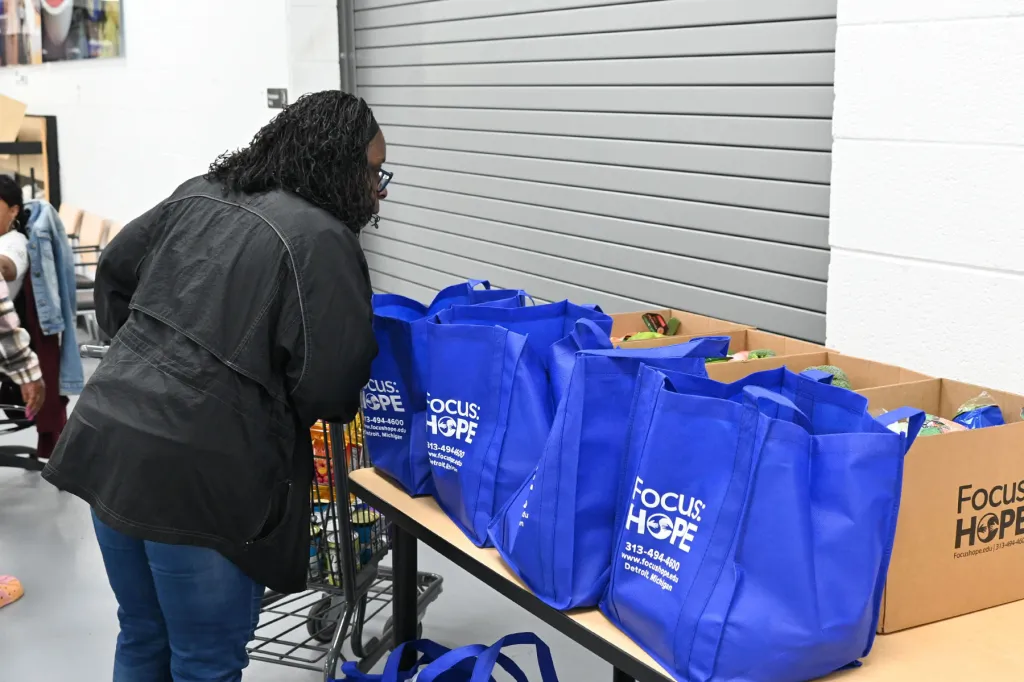
Frank Kubik, director of Focus: HOPE’s food program, says many seniors won’t voluntarily share how bad things are for them. He described what staff and volunteers do to understand the need without forcing someone to say it out loud.

(Courtesy of Detroit Focus:Hope)
“What we ask people to do sometimes when you’re delivering food is to ask if you can put it away for the senior,” Kubik said. “You don’t want to intrude, people sometimes don’t want to tell you their situations, and I get that.”
He explained the questions that could follow.
“Can I put it in your cupboard? Can I put it away in your refrigerator?” he said. “And then it gives you a chance to open up a cupboard or open a refrigerator and see what’s actually in there.”
Kubik described one home that has not left him, “A person had very little. And when I say very little, I’m talking about like a can of applesauce or something, and that was it.”
“How are seniors in this country living off a can of applesauce or something like that?… It’s just not right. It’s got to be a better way.”
The Social Security Administration estimated the average monthly retirement benefit for January 2025 was $1,976. For seniors on SSIe, the agency reported that in December 2024 the average monthly federally administered SSI payment for recipients age 65 or older was $576. All of which is supposed to cover rent, utilities, transportation, co-pays, prescriptions, food and the small costs that pile up quietly, including toiletries.
“It kind of just reminds you of how fragile things are and any disruption to whatever is already happening, whether it’s SNAP, whether it’s our program, whether it’s your Social Security check, it all has a huge impact,” he said.
Focus: HOPE’s Food for Seniors program exists because that stack of problems is real, and because someone has to meet people where they are, not where the system assumes they should be, Kubik said. Crawley has learned the same lesson from doorsteps.
The help that matters is the help people can actually reach, keep and use without losing their dignity in the process. Sometimes it looks like a warm meal. Sometimes it looks like groceries put away in a clean cupboard. Sometimes it looks like a conversation long enough for the truth to come out.