


Daycare strikes almost never happen. Here’s what drove these workers over the edge.
The trouble at the Sprout School started when staff began to turn over faster than they could be replaced. Twenty-five full- and part-time teachers dwindled to 10, leaving behind empty spots on the bulletin board by the school entrance that was once full of smiling faces.
“Teachers were disappearing and we weren’t understanding why,” said Chloe Haynes, a small business owner whose two sons attend the childcare center at the Second Presbyterian Church in Richmond, Virginia.
What has happened there over the past year has escalated into something almost unheard of in childcare: Last week, five of the remaining full-time teachers went on strike.
Childcare teachers, some of the most underpaid and under-resourced workers in the country, are rarely unionized. Unlike with K-12 education, there is no organizing structure for these teachers to strike when conditions deteriorate in an industry that at a baseline is suffering from a staffing crisis. Their work is also essential; teachers have to consider whether striking could lead babies and toddlers to be displaced from the care their families rely on.
So what would have to happen to drive a group of essential workers with no childcare organizing history to take collective action? How bad would it have to get for the parents whose childcare was disrupted to stand up in support of the teachers? And how did this all get so out of hand that now the school is disenrolling the children of parents who spoke up?
Jacque Williams, the lead teacher in Sprout’s 2-year-old classroom, said she was often caring for more children than state law allows. In Virginia, one teacher cannot be in charge of more than eight 2-year-olds, but Williams said she was sometimes caring for 12 students alone.
The lack of support made it difficult for her to uphold the school’s mission. Sprout has five play-based childcare facilities in Richmond that say they center a trauma-informed care approach. The schools are part of a program with the YWCA Richmond, whose stated mission is to eliminate racism and empower women.
But Williams didn’t even have time to go to the bathroom, she said, much less provide trauma-informed care. She avoided drinking water. She tried to not take time off work at all. The school also fired its kitchen staff in March, so teachers had new responsibilities, taking on washing the dishes and doing the laundry, which they usually did at the end of the day.
“I haven’t had a consistent assistant teacher for at least a full school year,” Williams said.
One of her students — a high-needs child who required constant supervision — jumped a fence on the playground one day. He wasn’t hurt, but he was temporarily unenrolled until his parents could secure a behavior analysis for him.
“I really feel like I’m losing executive functioning skills,” Williams said. “By the time I get home at the end of the night, I can’t do anything. I’m neglecting just daily chores, just daily things that I know I need to do to take care of myself. I’ve reached past mental capacity to do anything.”
Avva Tarwater, the lead preschool teacher, said her class cycled through three lead teachers in six months before Tarwater became the lead teacher in February.
“Kids were really dysregulated, were really struggling with all the transitions, constant in and out,” Tarwater said. “I needed behavioral support, I really did. There was no infrastructure to write or implement a behavior plan for my students.”
Tarwater’s classroom is next to the school entrance. When parents rang the bell for drop-off, she’d have to bring her 3-year-old students with her to the door because she couldn’t leave them alone in the classroom. It would happen something like 30 times every morning, interrupting all instruction.
The dwindling staff and lack of support became apparent to the parents, too. Haynes said that from her point of view, things really took a turn after two teachers died this year — one in a hit-and-run and the other due to surgery complications. When the school found out about the second death in May, administrators gathered the teachers and the students during a scheduled butterfly release in the playground and delivered the news. Chaos ensued, Haynes said. Teachers cried. Students cried. Parents frantically texted each other to pick up the kids and give the teachers a break.
Morale shifted.
“Children were asking their parents: ‘Did that kid die or did that teacher die?’” Haynes said.


Some Sprout School parents supported the daycare’s teachers by writing a letter to the board saying that the staffing crisis was creating instability for the kids and putting unsustainable pressure on educators.
On October 5 — World Teacher’s Day — five Sprout School teachers went on strike.(Courtesy Chloe Haynes)
By September, the situation had reached a boiling point. The school was continuing to enroll students as teachers quit. In the weeks before the strike, parents started to take note of classrooms over ratio with only one teacher inside, Tarwater said. On a handful of occasions, parents showed up to drop their kids off only to be turned away due to insufficient staffing.
By mid-September, a group of parents decided to write a letter to the board of directors of the YWCA Richmond. They told the board that the staffing crisis was creating instability for the kids, putting unsustainable pressure on educators and making it “difficult to provide the learning environment families were promised.” Attempts by parents to volunteer or help at the school had gone “unacknowledged or unanswered,” they wrote.
In a letter reviewed by The 19th, Rupa Murthy, the CEO of the YWCA Richmond, replied saying the board shared parents’ “desire for safe, supported, thriving children, and well-resourced teachers,” and listed its pay, benefits and teacher development incentives as proof. Murthy does not have a background in childcare, but rather is focused on leading strategy for the broader YWCA Richmond. Her prior work has been focused on diversity and equity.
Murthy declined a request from The 19th to speak for this story by deadline.
By October 1, seven of the remaining teachers decided to write their own letter requesting that management pause enrolling new students until they were able to hire an assistant teacher in each of the seven classrooms. Another teacher had just put in her resignation. They threatened to strike if their request was not met.
The teachers claim that the response from school management during a staff meeting was combative. The message, Tarwater said, was: “If you are unhappy with conditions here, nobody is making you stay.”
On October 5 — World Teacher’s Day — five teachers went on strike.
Workers took collective action at a daycare in Seattle in 2023, where preschool teachers went on strike due to low pay. In 2018, another group of 130 Chicago-area Head Start workers went on strike claiming unfair labor practices. But examples like this are few and far between.
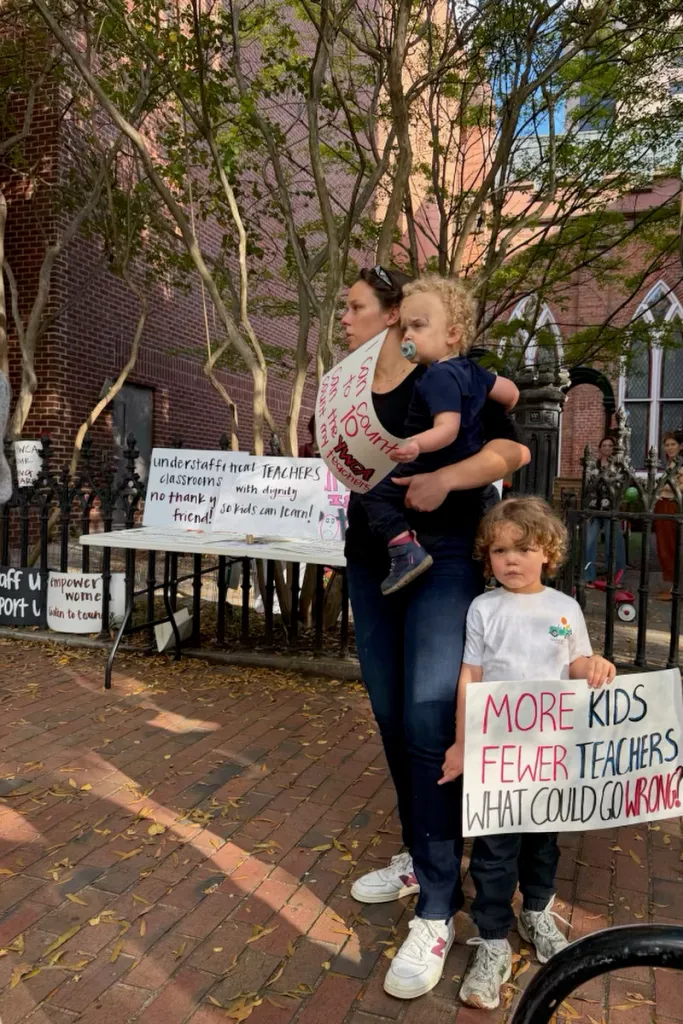
Outside Second Presbyterian that day, teachers, parents and their toddlers lined the brick sidewalk holding handmade signs. “Understaffed classrooms? No thank you, friend!” read Williams’s sign.
Two tiny hands held another sign: “I can’t spell ‘understaffed’ but I know what it looks like.”
Williams said she remembers looking around at her students, their parents and her fellow teachers, and realizing it was the first time in a very long time that she’d felt supported at her job. She felt a little guilty, too, because she knew her taking a stand came at a cost to the families who relied on her.
“I cried a lot [that day] because I had spent a lot of time recently feeling very unseen and unheard and every parent of every child that was in my classroom, even former parents, former teachers, parents from other centers, came out to support us,” Williams said.
Then at 4:53 p.m., an email arrived in the parents’ inboxes. The school would temporarily close, it said.
“These staffing challenges reflect what is happening in the early education and childcare industry across the country, and are also specific to our Second Presbyterian location,” Murthy wrote. “We are committed to ensuring state-approved ratios are consistently maintained.”
(Courtesy Chloe Haynes)
The crisis in childcare across the country is well documented. Childcare centers have low student-to-teacher ratios to ensure child safety, but that means that most of the money centers make has to go into paying teacher salaries. But even with sky-high tuition costs that put childcare at the top or near the top of most household budgets, centers are still struggling to pay their staff little more than minimum wage since most of their money goes toward teacher salaries. Profit margins are about 1 percent or less while the median pay for a childcare worker is just under $17 an hour.
In the week since the strike, parents have pulled together little childcare pods in their homes with kids of the same age and a teacher from the school to run them. Others have had to ask for help from grandparents or friends, like Molly McPhillips, who has an infant and a toddler at the center and is a high school teacher. One day last week her 3-year-old colored “Paw Patrol” in her classroom while her AP environmental science students took an exam. She has to work everyday; she can’t patch it together forever, she said.
“It just is crazy to me that I could be paying them $700 a week and they’re still systemically under-resourced. But that’s like the country we live in because they’re getting no or virtually no government funding,” McPhillips said. “I really fundamentally see this as a systemic problem. But then I am like, ‘Hey, you guys messed some stuff up.’”
Sprout said it plans to reopen in phases; three classrooms reopened this week. It’s also working to recruit teachers from other Sprout schools, telling parents via email that it has over a dozen teachers in its recruitment pipeline. Teachers have been paid during the strike, but it’s unclear when the remaining classrooms will reopen.
On Wednesday, though, new emails started going out.
Haynes got hers just before noon Wednesday: “YWCA Richmond’s Sprout School is unenrolling your child,” the email said, referring to her younger son. Haynes withdrew her older son from the school in late September. The email cited her actions ahead of the strike as leading to a “loss of trust in our ability to care for your children.”
Another parent who has been a vocal supporter of the teachers also got a disenrollment email that cited an “unplanned interaction” she had with management in the street prior to the strike that was “out of compliance with our Parent Handbook.”
Haynes is shocked. Her family enrolled at Sprout because they believed in the mission of the YWCA. It feels to her now like those values have been abandoned “when a parent speaks up for the teachers and demands accountability.”
“My only assumption is that this is retaliation for refusing to stay silent. Children should never pay the price for their parents’ advocacy,” she said. “A school that punishes questions and criticism is not listening to the community it serves.”
Mel Leonor Barclay contributed to this story.