

The real-life, offline campaign of Francesca Hong
MILWAUKEE — State Rep. Francesca Hong, Democratic candidate for governor of Wisconsin, looked out at a crowd of 1,300 supporters. Her earliest two were in the very front.
“My parents chose Wisconsin,” Hong said at a rally here this month. “They chose to follow their ambition because they knew that this state could be a state of possibilities.”
Now, Hong is following her own ambition.
Hong, a democratic socialist state lawmaker once seen as a long-shot candidate, is now the front-runner in the Democratic primary for governor of Wisconsin. At age 37, she’s vying to be the first democratic socialist governor in a state President Donald Trump won twice. She would also be Wisconsin’s first woman governor, first Asian-American governor and the first Asian-American woman governor elected in the United States.
Hong hasn’t made a point of emphasizing the historic nature of her candidacy in her campaign, but she often traces her story back to those of her Korean immigrant parents. “Representation is more than being the first,” she told The 19th. “I think there’s a responsibility to build a movement.”
A weekend Hong spent campaigning in Milwaukee and northern Wisconsin illuminated the central tension she’s facing in the final stretch. Her grassroots, policy-focused progressive campaign propelled her to the lead out of a fractured and chaotic Democratic primary field, a strategy she hopes to carry into the general election. But with fewer than 90 days before November 3, Hong is balancing the practical need to introduce herself to voters — and win over skeptics — with heightened scrutiny over her past social media posts and concerns that her past and current stances are too far left for purple Wisconsin.
She’s disavowed some of the more controversial positions she took online, like defunding the police and abolishing prisons. And despite Democratic Gov. Tony Evers’ assertion that “she’s spent her entire campaign dealing not with the issues, but what’s on the Twitter,” Hong keeps her message on the trail centered on policy.
“We’re running an issues-first campaign, so that folks know it’s less about the labels and it’s fully about the solutions,” she told The 19th in an interview in Wausau. “And people want, at times, to see their electeds and their candidates take a stance. And that shows very clearly where the values are, what somebody’s litmus test might be, how you’re going to lead, that you’re unafraid to make the decisions that may be politically uncomfortable or politically expedient.”
At an event at Alice’s Garden, a community garden and urban farm in Milwaukee, she spent nearly an hour taking questions from a handful of supporters and talked at length about food security, tax policy, support for veterans, marijuana legalization, education and healthcare. She joked that her policy plans included “making shared revenue sexy again.”
“And if folks are talking about defund or democratic socialism or that I’m a commie, I am not. I never will be, and have never been,” Hong said. Being a democratic socialist, she added, “means that I care about the people holding me accountable to fix problems.”
Wisconsin is known for its rancorous and bitterly divided political climate, but it has never seen a matchup quite like the one that could take place between Hong and likely GOP nominee Rep. Tom Tiffany, a staunch conservative and Trump ally who supported Trump’s efforts to overturn his 2020 election loss.
Bonnie Roeder-Smith, a Tiffany supporter who was working the Wisconsin Republican Party booth at the Wausau Hmong Festival with her husband and granddaughter, said Hong and Tiffany “are on opposite ends” of the spectrum.
“The community will be split,” she said, fearing that in a race between Hong and Tiffany, “people will lose their humanity.”
Much of the national narrative surrounding the race has focused on the dramatic twists and turns in the Democratic primary, with multiple candidates dropping out and Evers recruiting Milwaukee County Executive David Crowley to rejoin the race in a last-ditch effort to stop Hong from earning the nomination.


But as polls show her in the lead, Hong is traveling the state to talk policy, not political drama. In addition to Milwaukee, Hong went to northern Wisconsin and met with leaders in the Menominee Indian Tribe of Wisconsin and in the Hmong community, groups of voters who will be critical to her coalition — and to her general election chances against Tiffany, who represents those counties in his district.
Politicians from both parties gathered in the beer tent to shake hands and speak to voters at the Hmong Festival. Wisconsin is home to the U.S. third-largest community of Hmong Americans, many of whom are descended from refugees who came after the Vietnam War. While there isn’t reliable data on how Wisconsin’s Asian-American and Hmong populations vote, the nearly 60,000 Hmong Americans have the ability to influence election results.
“I think it’s important to recognize this community is not a monolith, whether it comes to political ideology or faith,” Hong said. “It’s my job to be a partner, not to come in and tell them how to live their life.”
In Wausau, Hong talked about her work on bipartisan legislation requiring K-12 public schools to incorporate Hmong and Asian-American history and culture into their curricula and highlighted some of her signature campaign proposals, which include a $20 minimum wage, free universal childcare and a statewide one-year moratorium on new data center construction. Raising wages, funding public schools and opposing data centers, Hong argued, are her top issues with crossover appeal to Republicans.
“If we don’t want to come back to these types of moments where we’re making it harder for people to have affordable lives, then we better make sure that we fight for the solutions that actually meet the moment,” she told the crowd.
Republican State Rep. Pat Snyder, who represents Wausau, has served with Hong in the legislature and said they’ve “disagreed on a lot of different things,” though both worked on the Asian-American Education Bill. He said Hong’s efforts, in addition to a recent media tour by the leaders of the national Democratic Socialists of America, might not be enough to win over skeptics, especially older voters who make up a larger share of the electorate.
“For some of the purple-state Wisconsinites that might be Clinton Democrats or Kennedy Democrats, this is kind of going a little far. So I don’t know. It’s such a question mark. I tell you, I just don’t know what to expect,” he told The 19th.
“It’s such a weird thing, but it gets weirder every election cycle,” he added.
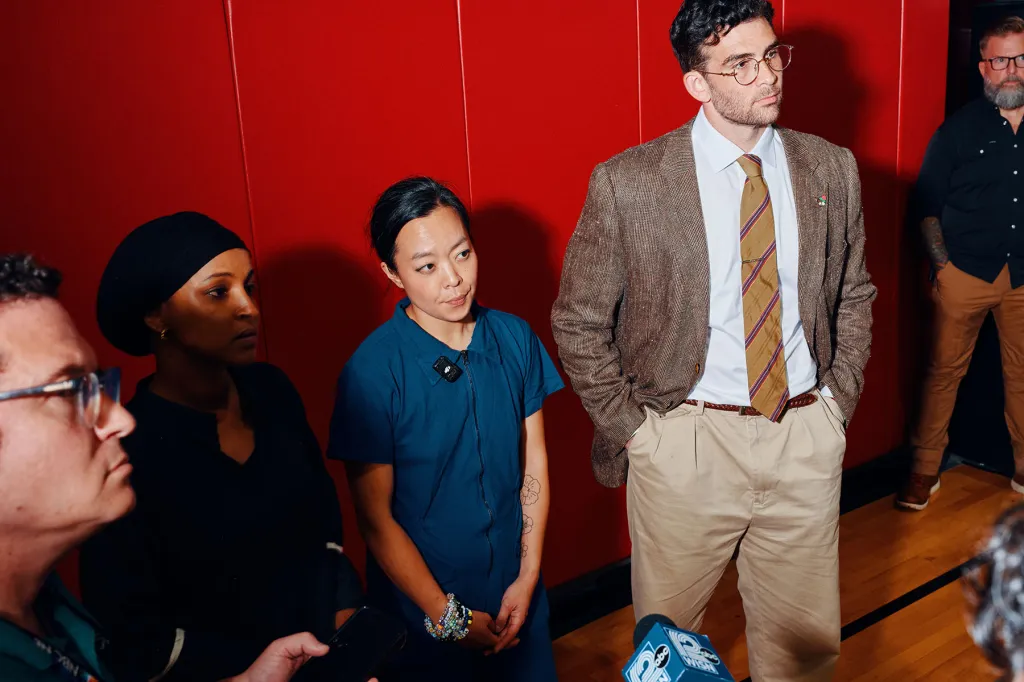
There’s no question that Hong has galvanized progressives; some 1,300 came to the Milwaukee rally with two high-profile national surrogates: Rep. Ilhan Omar of Minnesota and Twitch streamer Hasan Piker, a fellow democratic socialist.
Oliver Krawcyzk, standing in the front row, said he hadn’t seen the same kind of energy from a campaign since Sen. Bernie Sanders’ 2016 run for president. “She really stands for something,” he said of Hong, adding that her opposition to new data center construction has especially resonated with him following the failed Foxconn domestic manufacturing project during Trump’s first term.
(Caleb Alvarado for The 19th)
“Tech bros are not welcome in Wisconsin,” he said.
And Ashley Mertes, who leads two local mutual aid groups, attended the event at Alice’s Garden and then spent her birthday at the rally on Sunday. “I think it’s always been there, this hunger for change,” she said. “We can change the system.”
Hong has spent much of the final stretch of the campaign, including most of her national media interviews, clarifying and distancing herself from stances put forth in her six- to seven-year-old tweets. Despite her efforts to keep the race focused on policy, Republicans are already making the posts a major line of attack in the general.
Tiffany, who has amassed a significant fundraising advantage over Hong, is attacking her as extreme and out of step with voters, saying Wisconsin “will be the firewall that stops socialism from spreading across America.”
“I know that those ads are going to be nonstop, and that’s why we’re making our positions clear,” Hong said. “We’re going to have new videos come out that show folks who I am: small business owner, single mom, born and raised in Wisconsin, and ready to tax the billionaires and take on the data center crisis.”
Hong is also sharpening her attacks on Republicans and on Tiffany: She’s called him “a pedophile protector” in tying him to the late sex offender Jeffrey Epstein, and highlighted his vote against affirming the 2020 election results and for Republicans’ party-line tax cut and spending bill.
“He doesn’t share Wisconsin values. He doesn’t work as hard as the people of Wisconsin. I’m starting to tell folks about all the votes that he missed in Congress,” she later told The 19th. “He is somebody who is more loyal to Trump than the people of Wisconsin.”


At a powwow in Keshena on the Menominee Indian Reservation in Menominee County, a reliable blue dot in a sea of red, Hong took photos with supporters and stayed late. She held in-depth conversations with tribal leaders and tribal legislators. She bought a pair of earrings, took home some fry bread and lingered to chat with the last remaining vendors.
Christopher Peguero, a Hong supporter and a member of the Menominee Nation, drove up from Madison with his son to attend the powwow. Peguero, a member of the Verona Area School Board, and his husband have a transgender child in a community that has been affected by federal cuts targeting healthcare systems that provide gender-affirming care. “Whatever we can do to keep Tom Tiffany out,” he said.
Jolene Reed, a voter who lives in Keshena, said she had only recently learned about Hong’s candidacy but appreciates her support for tribal communities and is “really excited” to see a woman of color running. “We’ve never had a woman, period,” she said.