

For Black women with Tourette syndrome, long-standing invisibility meets viral attention
Black women with Tourette syndrome have long felt invisible. A shocking moment at the British Academy Film and Television Arts awards ceremony, involving a racial slur broadcast to millions, has thrust them into the spotlight.
Suddenly, the videos they posted on social media platforms like TikTok and Instagram racked up hundreds of thousands of views when previously, the audience had been small; there are very few Black women with Tourette syndrome, or very few who have been diagnosed and whose tics have been believed.
In fact, none of the women The 19th interviewed for this story had met another Black woman with Tourette syndrome until adulthood. Their journeys have been marked by doubt and confusion that has not abated as the controversy from the broadcast continues to unfold. Last weekend, a Saturday Night Live sketch used Tourette syndrome to explain the antisemitic, transphobic and even cannibalistic comments of certain celebrities.
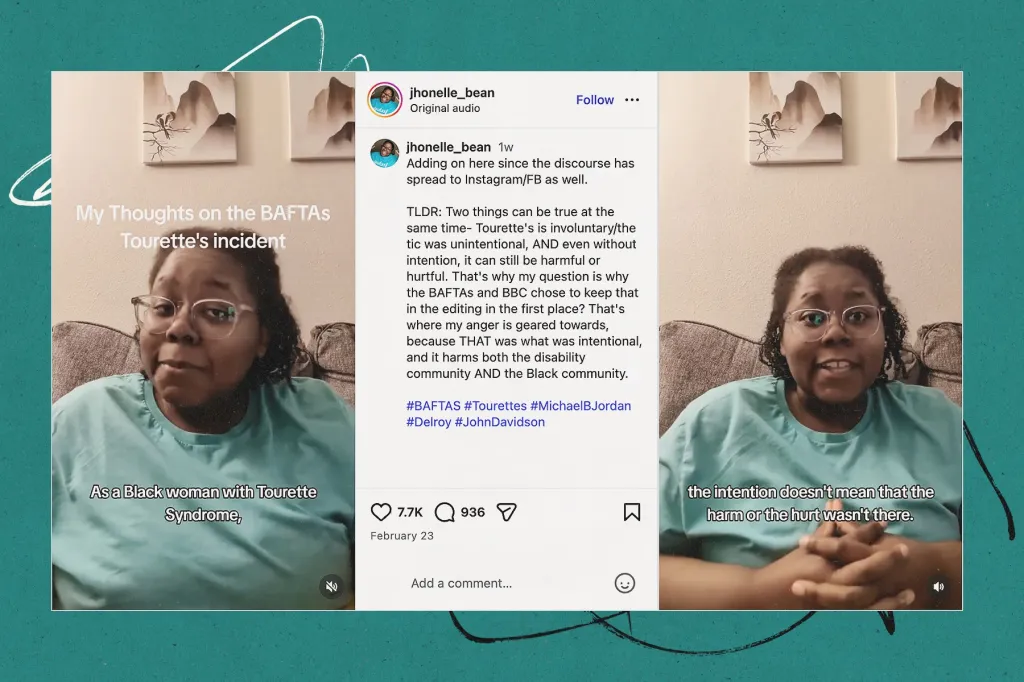
Jhónelle Bean, 30, has been inundated with interview requests since her videos on Tourette syndrome went viral following the awards ceremony. In her most recent videos, Bean explores the complexity of being impacted in multiple, intersecting ways by the incident. She also discussed the conversation surrounding it — the need for empathy and understanding toward people with Tourette syndrome, as well as the heavy history and harm of the slur for Black people.
Bean is a sign language interpreter from San Antonio, Texas. When she started making videos in 2020, she wasn’t looking for virality or fame. Instead, she was motivated by the anxiety and isolation of the early COVID-19 pandemic because stress can worsen tics for many people with Tourette syndrome. She wanted to reach out to other people like her, who were experiencing what she was experiencing.
“I wanted to speak on it because I remember not finding many people that looked like me talking about [Tourette syndrome], and I wanted to be a potential resource for someone else experiencing it during that tough time,” Bean said.

(Emily Scherer for The 19th)
Social media was the first place Emauni Crawley, 23, saw another Black woman with Tourette syndrome; she’s a fan of Bean’s videos. She is a behavioral health coach living in Durham, North Carolina, who was diagnosed with Tourette syndrome when she was 7 years old. She first met another Black woman with Tourette syndrome in real life two years ago, at a Tourette Association of America advocacy day in Washington, D.C.
She still remembers the feeling: “OK, OK, God, it’s not just me,” she said. “There are other Black women out here going through similar experiences as me.”
Crawley’s mother, a licensed therapist, was her biggest advocate and still struggled to find resources when Crawley was growing up. “All she could find were people with Tourette’s syndrome that were White males. She was never able to find anybody that looked like me, not even a Black man,” Crawley said.
About 1.3 million Americans have Tourette syndrome, according to the Centers for Disease Control and Prevention. It isn’t currently possible to estimate how many are Black women because the available data is so limited, according to Marisela Dy-Hollins, a pediatric neurologist and movement disorder specialist at Massachusetts General Hospital who is one of only a handful of researchers who have focused on Tourette syndrome, race and gender.
Crawley also faced misunderstanding from medical professionals. She remembers getting an X-ray a few years ago; the technician, a Black man, seemed surprised by her tics.
“He kept asking, ‘Are you OK?’ And I was like, ‘Yeah, I’m good. I just have Tourette’s,’” she said. “He was like, ‘What?’ He looked at me, and he pointed to the [paler] inside of his palm, and was like, ‘Oh, I thought that was a White people thing.”
She told him anyone can have Tourette syndrome, but the interaction got her thinking.
“How many people think that? There are health care disparities when it comes to people of color in general. Statistics show that. White people have a better chance of being diagnosed with Tourette syndrome than any other community,” Crawley said. “For the Black community, there are health care disparities, there’s lower socioeconomic status, lack of resources — there’s so many different reasons, and stigma is also still prevalent.”
In a 2024 paper in the journal Pediatric Neurology, Dy-Hollins and her colleagues wrote about how they had tried to use one of the larger and most commonly used datasets on Tourette syndrome to draw conclusions about people with Tourette syndrome from different ethnic and racial backgrounds. But it wasn’t possible because people who weren’t White made up less than 10 percent of the dataset.
“There weren’t enough people to really make a meaningful statistical analysis,” Dy-Hollins said.
In a different paper, published in the journal Neurology last year, Dy-Hollins and colleagues were able to use the same dataset to determine that women with Tourette syndrome were less likely to be formally diagnosed, were diagnosed at later ages and took longer for professionals to diagnose.
There is little specific research on Black women and girls with Tourette syndrome because of sampling and underdiagnosis.
“If people are not recognized or diagnosed early, then they’re not being seen in the clinics, right? There’s this potential bias saying that maybe people who are from racial, ethnic minority backgrounds, they don’t have tics and Tourette syndrome. But maybe they just don’t make it to our clinic. It could also be access to care, referral patterns, potentially mistrust of the medical community, or even cultural factors. It’s complex. And then you try to look at the intersection between race, ethnicity and sex, and there’s not enough data available,” Dy-Hollins said.
Chloe Winston, 24, works at a hospital. This fall, she will go back to school to study nursing. She was diagnosed with Tourette syndrome when she was 17, after two years of unexplained tics and skepticism from some doctors. She struggled to transition from a pediatric psychiatrist to one who treated adult patients. One of the first ones she met with, a White man, didn’t believe her.
“He just straight up was like, ‘Oh, I’ve never met a Black person with Tourette syndrome before.’ He didn’t think I had it, because he’d never met anyone with it who looked like me. He was like, ‘Are you sure? Have you been checked for anything else?’ And I was like, ‘No, I do have it. I did check. I promise,’” Winston recalled.
She has been able to meet younger Black girls with Tourette syndrome through her work with Camp Twist and Shout, a summer camp for children with Tourette syndrome. She said she’s frustrated that she doesn’t see people like her on TV shows.
“Pretty much all of the Tourette representation is White guys, except for that one lady on TLC,” Winston said, referring to reality television star Baylen Dupree.
“I wish there was more diversity. I think the fact that it’s only White people [in media] reinforces the stereotype that people of color don’t get [Tourette syndrome], which is very far from true,” she said.
Both Crawley and Winston have found more representation on social media than traditional media. Bean was the first Black woman with Tourette syndrome Winston ever met in real life, and Winston was the first Black woman with Tourette syndrome Bean ever met in real life. “We’re still friends today,” Bean said.
Their meeting wasn’t without difficulties, however. She and Winston were the only Black women at a Tourette syndrome conference that year. People kept getting them confused, even though they do not look particularly alike. At the time, Winston had pink braids, while Bean’s hair was in a dark bun. After a while, they started jokingly calling each other “twins.” Bean described the incidents as “microaggressions,” a form of subtle and unintentional discrimination.
Bean has mixed feelings about the attention the British film awards brought to her and others in the Tourette syndrome community, particularly Black members of the community. On one hand, it has been an opportunity to educate. On the other hand, a lot of people still have major misconceptions about people like her.
“Speaking for myself and some of my friends with Tourette’s, we’ve all experienced a bit of an increase in our tics due to stress or anxiety from everything. Things like that can exacerbate the symptoms we deal with,” she said. “While the world will move on to the next big topic in a few weeks, we will still feel the effects of it in our bodies.”