

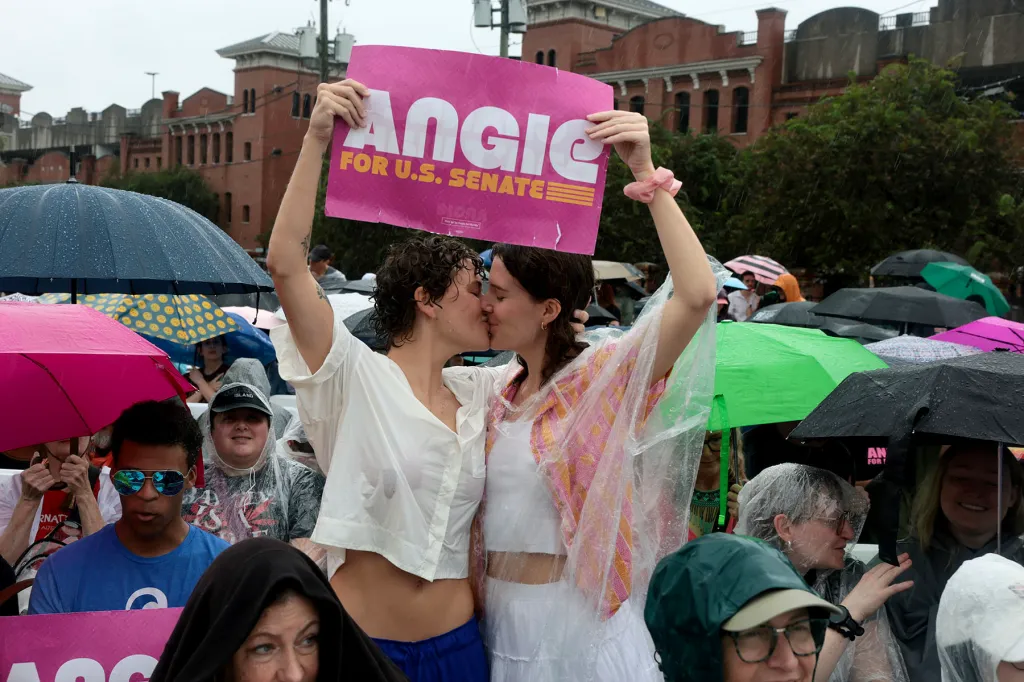
Angie Nixon has been working years for this moment
This column first appeared in The Amendment, a newsletter by Errin Haines, The 19th’s editor-at-large. Subscribe today to get early access to her analysis.
Most people had no idea who Angie Nixon was until a few months ago.
Maybe the three-term Florida state legislator came onto their radar in April, after her one-woman protest in a pink jumpsuit and matching bullhorn on the House floor against the special session to gerrymander the state just hours after the Supreme Court’s decision to gut the Voting Rights Act went viral.
Perhaps it was Nixon’s stunning and decisive primary win in August that made a progressive Black woman the face of the Democratic Party’s political fortunes in Florida. Or maybe it was another viral moment, courtesy of Vice President JD Vance, who suggested at a rally earlier this month that she should “get the hell out of here” and that she doesn’t belong in America if she calls herself a socialist.
But Nixon, who now seems to be everywhere, did not come out of nowhere. Her improbable rise to become Florida’s Democratic nominee for U.S. Senate is the result of a decade of preparation meeting political opportunity, challenging notions of electability in a state that’s increasingly moved toward Republicans. In the final weeks of the race, Nixon’s virality and scrappy approach are getting attention and may be paying off, as donors have given the campaign a much-needed boost.
“People are pissed. They’re struggling,” Nixon said in an interview. “They want to feel like they can talk to elected officials and they are listened to. But Donald Trump and Ashley Moody, they’re turning their back on folks. I believe the government should work for people, but right now it’s actively working against them. And so I am running because we need to send someone to Washington, D.C., that’s going to stand up to Donald Trump and make him listen and do right by everyday Floridians and Americans in this country.
If elected, Nixon would become Florida’s first Black senator and could be one of a record four Black women senators serving simultaneously. Her candidacy has expanded the political imagination of her state and country about who can win statewide — and who gets to claim Florida’s future.
There are a lot of variables that create an Angie Nixon moment, said Glynda Carr, president of Higher Heights for America, a political action committee that works to put more Black women in office and has endorsed Nixon.
“What makes her a compelling candidate is when she tells her personal why, and why that has driven her to be an advocate, an organizer and a legislator — that speaks to people,” Carr said. “She may be being outspent — Democrats are being outspent in most places, and Black women are always outspent. What she has said is people can’t outwork her.”
Nixon faces an uphill battle headed into November. Republicans have 1.5 million more registered voters in Florida, and President Donald Trump won the state in 2024 by 13 points. While Nixon remains competitive in the final weeks of the general election, most polls show her still trailing her opponent, Republican incumbent Sen. Ashley Moody, by several points. Only one Black woman, former Lt. Gov. Jennifer Carroll, has ever won office statewide in Florida.
The odds are not lost on Nixon, who campaigned last week in Monticello, on the Georgia-Florida border, about 45 minutes outside of Tallahassee. When she took the stage, Nixon was met with a wave of enthusiasm whose energy she matched. She made her case to the Jefferson County audience of mostly older, White voters in a city with a 43 percent Black population and a county that Trump won by 19 points in 2024.
“We’re working so hard and then they tell us, ‘You’re not working hard enough.’ Meanwhile, they’re working less and less and less and getting richer,” Nixon told the crowd as they nodded in agreement.”
“We have the opportunity to do something different in these next 250 years,” she continued as the audience clapped and cheered. “We have the opportunity to build a new vision for our country, y’all. One where everyone can be healthy, prosperous and safe, and experience rest and joy.”
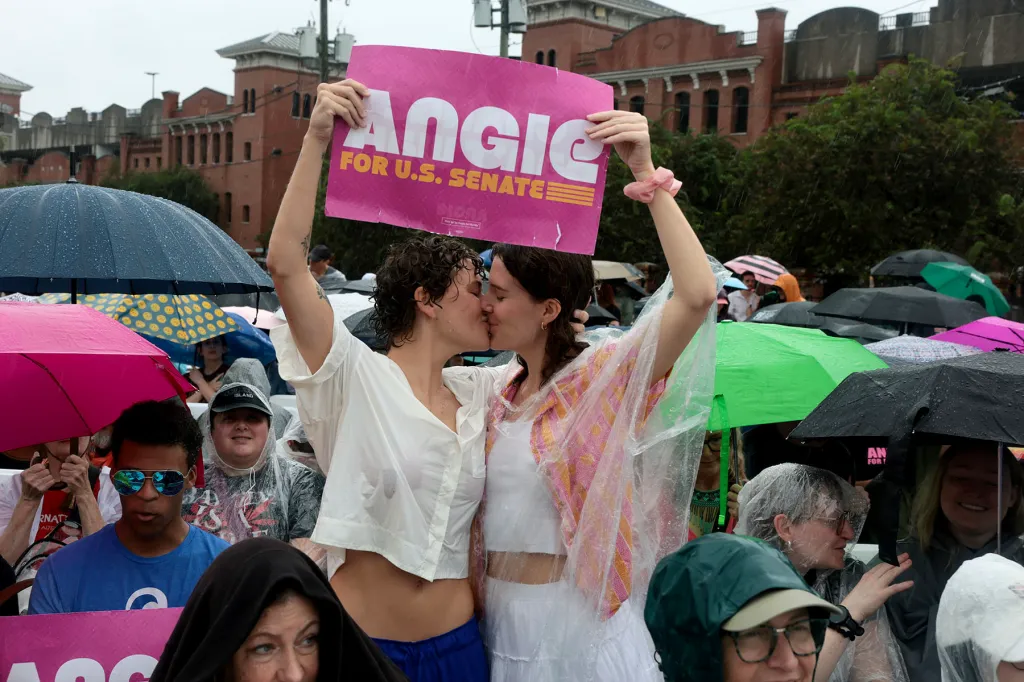
Afterward, as volunteers broke down the room at the Monticello Opera House around her, Nixon stopped to chat and take pictures with the voters — old and young, moms and children, of different backgrounds and races.
“My coalition needs to be diverse,” Nixon said in an interview. “I can’t just go have conversations with Democrats. I have to have conversations with independents, with Republicans, with members of any other third party. And we have to work hard on talking to them, cutting through the noise, and letting them know we hear them, we care about them, and we’re going to help provide some relief.”
(Joe Raedle/Getty Images)
On the stump, she has been focused on affordability, centered on issues that are popular among many voters. Her platform includes paid family and sick leave, a national rent freeze and moratorium on evictions, a universal jobs program and Medicare for All — some of the same policy priorities of the Democratic Socialists of America. Nixon is a member of the progressive group but has said she is not completely aligned with all of the group’s policies.
While Nixon is a progressive candidate, she knows it will take a broad coalition of Floridians — including some who may not have been open to voting for a Democrat, a Black woman or both — to win in November. Her message aims to appeal to voters’ interests and not just their ideology, a rejection of the idea that she’s someone who doesn’t belong in this country.
“Her biggest asset is her ability to be in front of voters,” Carr said. “She’s building a grassroots, final drive that is a blueprint. We’re going to see more candidates that look, talk, and believe in the values that Angie Nixon believes in. She’s not an anomaly.”
Voters may be getting to know Nixon, but she has spent years getting to know them.
For two decades, she has been an organizer in Florida, and she was first elected to the state legislature in 2020. On her campaign website, she touts her record as the former executive director of Florida for All, a statewide coalition of progressive groups that has helped register tens of thousands of voters.
As a sitting state legislator who knows how to run local elections as an organizer and candidate, Nixon has a résumé that has prepared her for Washington, said Carr.
“That is certainly a skill set that should be welcomed in Washington. She’s going to hit the ground running and understand the process. It’s not just like, ‘Oh, here’s this woman who is inspiring, who people are interested in what she has to say, she wears pink, she has a bullhorn.’ She has all of that — and she also has the experience.”
What can look like a surprise candidacy to some is the culmination of years spent building relationships and registering voters. In the decade that Nixon has contemplated her run, the political landscape has also changed.
In 2016, Kamala Harris became only the second Black woman elected to serve in the U.S. Senate. Her election came 20 years after that of the first Black woman senator, Carol Moseley Braun of Illinois. A decade after Harris’ election, there are two Black women senators — Democrats Angela Alsobrooks of Maryland and Lisa Blunt Rochester of Delaware — making history as the first Black people elected as senators from their respective states and the first Black women to serve simultaneously in the Senate. In November, Illinois Lt. Gov. Juliana Stratton is poised to join them, meaning at least three Black women would be serving in the Senate together. Nixon’s path is more challenging, but she could become the fourth.
“In a decade, that’s a lot of movement in the highest chamber,” Carr said. “And that Black women are starting to chip away at this thought that Black women can’t run statewide. She didn’t have permission. For all intents and purposes, she shouldn’t have even filed. It’s Florida; it’s a Black woman.”
For much of the race, Nixon’s campaign was strapped for cash and didn’t have much support from PACs or wealthy donors. She raised $975,000 during the primary, largely from small donors and social media, against an opponent who raised more than $16 million. But the latest campaign finance reports show that Nixon outraised Moody in the third quarter, with the candidates reporting fundraising totals of $7.6 million and $5.8 million, respectively. Moody holds the overall advantage, with a total haul of more than $14 million, and has so far outspent Nixon by 32 to 1.
Nixon is among the increasing number of Black women who are running for statewide office up and down the ballot. They are expanding their ambition beyond what has already been proven — the mayor’s office, seats in Congress — and running difficult races in difficult states, courting voters and challenging the institutional status quo. Slowly, they are normalizing whose candidacies should be considered by claiming their right to contest their place and power in our democracy.
“I love my state, and so I’m going to fight for it, because it’s mine,” Nixon said. “It’s everyone’s here in the state. It’s our Florida.”